




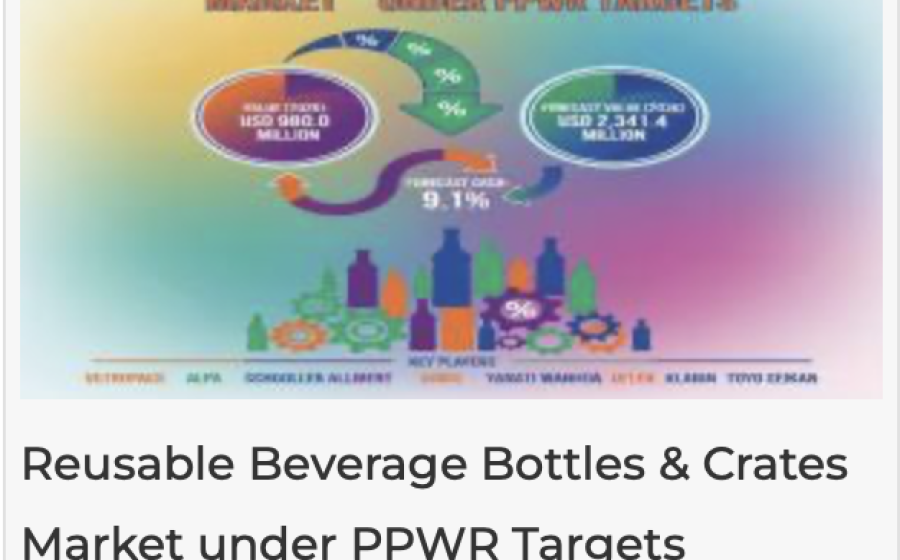

The global Reusable Beverage Bottles & Crates Market is entering a decisive growth phase as regulators, beverage producers and retailers move away from recycling-led packaging strategies toward mandatory reuse systems. Valued at USD 980.0 million in 2026, the market is projected to reach USD 2,341.4 million by 2036, expanding at a compound annual growth rate (CAGR) of 9.1% over the forecast period.
A key catalyst behind this momentum is the European Union’s Packaging and Packaging Waste Regulation (PPWR), which introduces binding reuse targets for beverages. Under the regulation, alcoholic and non-alcoholic drinks must achieve a minimum 10% reuse rate by 2030, forcing beverage brands and packaging suppliers to redesign supply chains around durable, refillable packaging formats. The impact of PPWR is extending well beyond Europe, influencing global packaging strategies and investment priorities.
From Recycling to Reuse: A Structural Shift
The reusable beverage bottles and crates market includes durable glass bottles, refillable PET bottles and high-density polyethylene (HDPE) crates designed for closed-loop logistics systems. Unlike single-use packaging, these assets are engineered to withstand 25 to 50 refill cycles, delivering measurable reductions in packaging waste and lifecycle carbon emissions.
Several converging forces are driving this structural shift:
- Regulatory enforcement under PPWR, making single-use packaging increasingly costly and non-compliant
- The resurgence of deposit-return schemes (DRS) across Europe and emerging pilot programs in other regions
- Corporate net-zero and circular economy commitments, particularly among multinational beverage producers
- Volatility in virgin PET and glass prices, encouraging long-term asset ownership through reusable packaging fleets
Together, these factors are transforming reusable beverage packaging from a sustainability niche into a core operational requirement.
Market Snapshot (2026–2036)
- Market Value (2026): USD 980.0 million
- Forecast Value (2036): USD 2,341.4 million
- Forecast CAGR: 9.1%
- Leading End-use: Retail refill & deposit systems (40%)
- Leading Materials: Glass and rPET (50%)
- Leading Technology: Reverse logistics and sanitisation systems (45%)
- Key Growth Markets: India, China, Germany, Brazil, USA and Japan
How the Market Is Structured
The market reflects the operational realities of returnable packaging ecosystems:
- By End-use: Retail refill and deposit systems dominate, followed by on-trade channels such as restaurants, bars and catering services
- By Packaging Format: Primary reusable bottles are supported by secondary transport assets, including crates and carriers
- By Material: Glass and refillable PET coexist, balancing durability, weight and transport efficiency
- By Technology: Automated washing, inspection and reverse-logistics infrastructure enable scale, hygiene and compliance
Each segment plays a critical role in ensuring reuse systems operate at industrial speeds comparable to single-use packaging lines.
Retail Refill Systems Drive Bottle Design Evolution
Retail refill and deposit systems account for the largest share of market revenue, supported by mature infrastructure in Central Europe and expanding pilots globally. To perform reliably in these systems, reusable bottles are engineered with:
- Thicker walls and reinforced bases
- Scuff-resistant surface coatings
- Compatibility with reverse vending machines (RVMs)
These design features deliver the lowest environmental impact per liter consumed, positioning reusable bottles as a preferred compliance pathway under PPWR.
Material Innovation Balances Weight and Durability
Glass and refillable PET (rPET) remain the dominant material combination:
- Glass continues to lead in beer and premium beverages due to chemical inertness and brand perception
- Refillable PET is gaining share in soft drinks and bottled water, supported by lower transport emissions
Manufacturers are advancing high-performance PET blends with enhanced thermal stability, allowing bottles to withstand hot caustic washing without deformation. This dual-material strategy enables reuse systems to scale across diverse beverage categories.
Reverse Logistics as the Economic Backbone
Efficient reverse logistics are critical to the economic viability of reuse models. As a result, washing, inspection and return systems represent the leading innovation stream in the market.
Key developments include:
- Automated crate washing and bottle inspection using optical sensors
- High-speed systems that match the throughput of single-use filling lines
- Centralised washing hubs near retail clusters to reduce transport emissions
These technologies underpin consumer safety, regulatory compliance and cost competitiveness.
Pool Bottles and the Push for Standardisation
A defining trend is the rise of standardised “pool bottles”, shared across multiple brands and refillable by local bottlers. This model:
- Reduces sorting complexity and transport distances
- Lowers reverse-logistics costs
- Decreases the overall carbon footprint of reuse systems
Industry consortia increasingly support pooling, positioning reusable bottles and crates as shared infrastructure assets rather than brand-specific packaging.
Regional Growth Outlook
Growth trajectories vary by region:
- India (CAGR 12.0%): Supply chain modernisation and organised logistics drive adoption
- China (10.5%): Strong on-trade demand supported by catering sector growth
- Germany (9.0%): A mature benchmark market optimising high-rotation refill systems
- Brazil (8.0%): Tourism and dining activity sustain returnable glass formats
- United States (7.2%): High beverage shipment volumes create circularity potential
- Japan (5.0%): Efficiency-driven adoption of standardised crates and ultra-durable bottles
Competitive Landscape: Integration Over Volume
Competition is increasingly defined by system integration rather than unit sales. Leading players are expanding beyond manufacturing into:
- Pooling and asset management services
- Smart tracking using RFID and Bluetooth
- Investments in regional washing and reverse-logistics hubs
Key market participants include Vetropack, ALPLA, Schoeller Allibert, Orbis, Plastipak, Yantai Wanhua, UFlex, Klabin and Toyo Seikan.