



Europe’s packaging industry is approaching a defining moment. With growing climate urgency, shifting consumer expectations, and the introduction of the EU Packaging and Packaging Waste Regulation (PPWR), circularity is no longer aspirational—it is mandatory.
At the Interpack 2026, TotalEnergies Corbion will demonstrate how its Luminy® PLA portfolio is already enabling high-performance, circular packaging solutions across diverse applications.
From advanced foam technologies to recyclable, label-free designs, the company’s presence at Booth 10 B58 underscores a compelling message: biobased materials can deliver performance, circularity, and significantly lower carbon footprints—today, not in the future.
PPWR: Redefining Europe’s Packaging Landscape
Published in 2025, the PPWR will come into force on 12 August 2026, making most of its requirements legally binding across EU Member States. The regulation sets out clear and ambitious goals:
- Reduce overall packaging waste
- Ensure all packaging is recyclable by 2030
- Increase recycling rates
- Introduce minimum recycled-content requirements
- Lower the environmental impact of packaging materials
For biobased materials like Luminy® PLA, this transition raises important questions: how will bioplastics integrate into Europe’s circular economy, and what role can PLA play in meeting these regulatory demands?
PLA: A Versatile Material for Circular Systems
PLA (polylactic acid) is a biobased polymer derived from renewable resources such as sugarcane. Through fermentation and polymerisation, plant sugars are transformed into a versatile material used in packaging, fibres, nonwovens, and durable goods.
What distinguishes PLA is its ability to fit into multiple circular pathways:
- Reuse in durable applications
- Mechanical recycling into new products (where regulations permit)
- Chemical recycling back into lactic acid for high-quality PLA production, including food-contact applications
- Industrial composting (certified under EN 13432) for specific use cases such as food-contaminated packaging
This flexibility allows PLA to integrate into diverse waste-management systems rather than relying on a single end-of-life solution.
Lower Carbon Footprint, Measurable Impact
A key environmental benefit of PLA lies in its biogenic carbon cycle. Feedstock plants absorb CO₂ during growth, storing atmospheric carbon within the material.
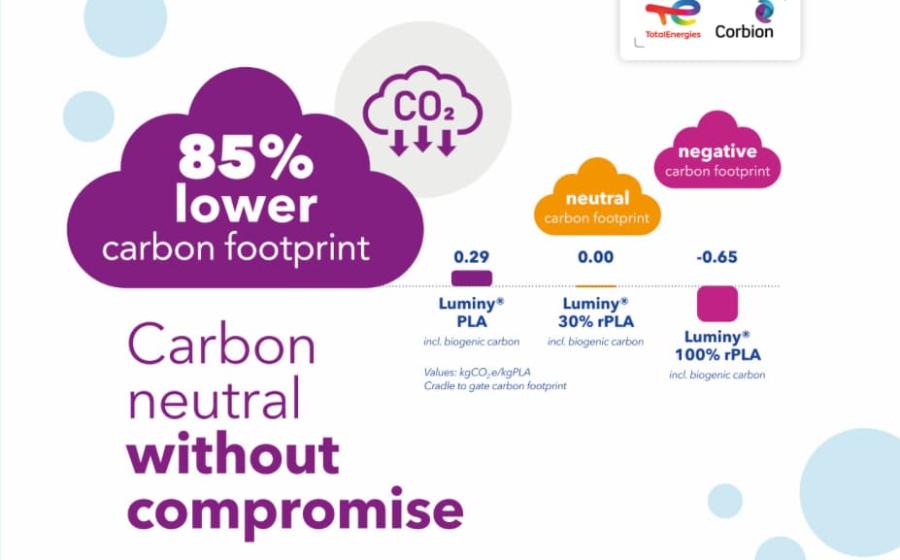
Life-cycle assessments indicate that Luminy® PLA can reduce carbon emissions by up to 85% compared to conventional plastics, with a cradle-to-gate footprint of approximately 0.29 kg CO₂-eq per kg (including biogenic carbon). When recycled, Luminy® rPLA can achieve even lower impacts—around –0.65 kg CO₂-eq per kg—making it a compelling option for companies targeting Scope 3 emission reductions.
Recycling and Compostability: Complementary, Not Competing
The PPWR acknowledges that compostable packaging can offer environmental benefits in applications where recycling is limited by food contamination. At the same time, PLA supports both mechanical and chemical recycling pathways.
TotalEnergies Corbion has already established commercial-scale chemical recycling of PLA, enabling the production of high-quality recycled material suitable even for food-contact applications. This demonstrates that circular PLA systems are not theoretical—they are already operational.
Innovation in Action at Interpack 2026
Real-world applications of PLA are expanding rapidly—from flexible and rigid packaging to foamed materials, nonwovens, and durable goods. Innovations such as label-free bottle designs highlight how material selection and product design can work together to enhance recyclability and improve waste-stream purity.
At Interpack 2026 (Booth 10 B58), TotalEnergies Corbion invites industry stakeholders to explore how Luminy® PLA is redefining the possibilities of circular packaging.