



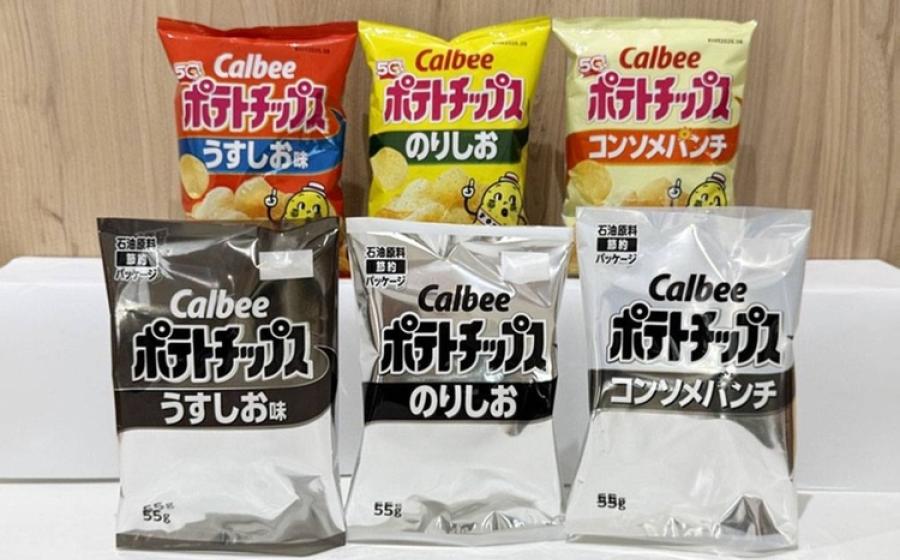

In a surprise move that could have industrywide repercussions, worries about a naphtha shortage due to the Iran war and a possible impact on ink production have led food manufacturer Calbee to switch to black-and-white packaging for some of its snacks.
“Calbee … will temporarily revise packaging specifications for certain products in response to supply instability affecting certain raw materials amid ongoing tensions in the Middle East,” Calbee said Tuesday.
The company will temporarily switch packages for 14 products, including a range of potato chips as well as the company’s signature Kappa Ebisen — which comes in bright red packaging — and Frugra, short for fruit granola, starting May 25.
Two of its Kataage Potato brand of chips, which come in 65-gram bags, will be sold in black-and-white packaging nationwide as well beginning June 22.
Calbee is not the only food manufacturer considering such a measure in response to the Iran war. On May 1, President Hiroyuki Urata of Itoham Yonekyu Holdings, whose products include packaged meats, said that a future switch to black-and-white packaging was possible.
Nisshin Seifun Welna, which makes quick-boil pasta, said in April it would start using paper tapes to bundle its pasta without any print to save on ink due to “the international situation.”
The Strait of Hormuz, which provided Japan with 93% of its oil imports, remains effectively closed as a result of the Iran war. With no sign of imports from the Middle East region returning to prewar levels anytime soon, the announcements by Calbee, Itoham Yonekyu, and Nisshin Seifun Welna have brought home to consumers the impact of the war on daily life.
Naphtha, an oil-derived product, is used for the production of ink for product packaging and Calbee’s hope is that a switch to black and white will help it conserve supplies.
The government maintains that there is enough naphtha for local industries. On Tuesday, Prime Minister Sanae Takaichi said that, based on last year’s production levels, the government had confirmed there was a sufficient supply of raw materials needed for the production of ink used for food packaging.
But Takaichi also admitted there have been bottlenecks — or situations in which specific materials or products are experiencing shortages. She said she has instructed relevant ministers to work on resolving them.
Takahide Kiuchi, an executive economist at Nomura Research Institute, said in a report in April that the supply of petroleum products, including naphtha, follows a multi-tiered structure that involves importers, refineries, wholesalers, trading companies, distributors, regional retailers, and then finally, end users.
“Government measures such as the release of strategic petroleum reserves and the expansion of procurement through alternative channels are policies designed to increase supply at the entry point of this chain,” Kiuchi said.
“However, if there are restrictions to shipment, uneven distribution or product backlogs by application occur at intermediate stages, petroleum products will not reach end users.”