




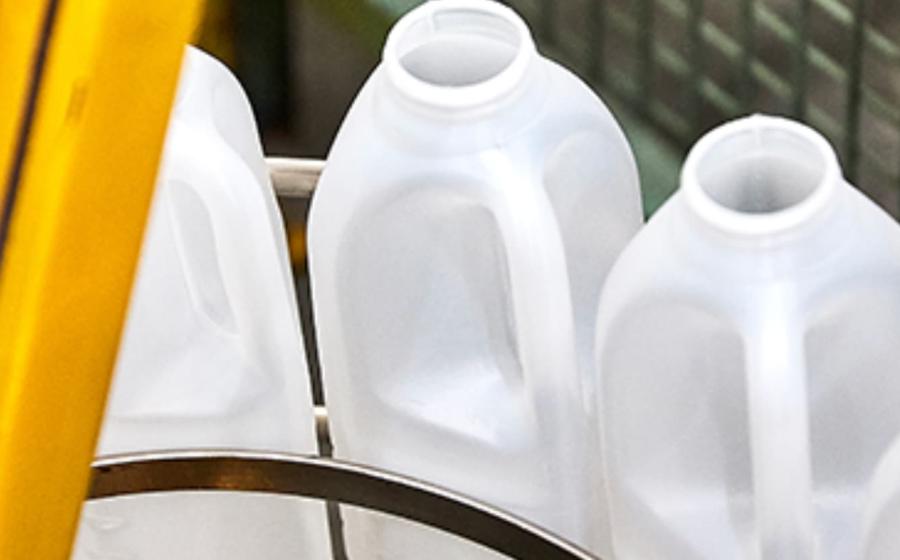

In a significant step toward circular food-grade packaging, Pact Group has confirmed that its recycled rFresh 100 natural HDPE resin meets stringent US Food and Drug Administration (FDA) safety requirements for direct food and beverage contact applications.
The resin is produced at the Circular Plastics Australia (CPA) recycling facility in Laverton, Melbourne, where post-consumer milk and juice bottles collected through kerbside systems are mechanically recycled into high-purity, food-grade HDPE. The process includes advanced sorting, shredding, washing, decontamination, and pelletisation to achieve virgin-like material performance.
According to Pact Executive General Manager Recycling, Shareef Khan, the recycled resin underwent comprehensive testing at international laboratories and was validated against US FDA 21 CFR 177.1520 requirements. The evaluation included chemical migration analysis and sensory testing to confirm suitability for dairy and beverage packaging.
US-FDA compliance enables packaging manufacturers to produce new milk and juice bottles using up to 100% recycled rFresh 100 HDPE, a milestone for closed-loop HDPE bottle-to-bottle recycling in Australia. The Laverton CPA facility is also FSSC 22000 certified and supported by an on-site quality laboratory to ensure ongoing regulatory compliance.
The food-grade recycled resin will be converted into milk, cream, sauce, and juice bottles, as well as personal-care containers, across Pact’s national packaging manufacturing network.
The CPA polyethylene recycling plant — a joint venture between Pact and Cleanaway Waste Management — has capacity to process up to 20,000 tonnes of HDPE dairy and beverage bottles annually, equivalent to roughly 500 million two-litre milk bottles.
Beyond regulatory achievement, the innovation delivers measurable sustainability benefits. Independent lifecycle studies indicate that replacing virgin fossil-based HDPE with recycled content significantly lowers carbon emissions while diverting large volumes of plastic waste from landfill.
Khan emphasised that well-designed, recyclable plastic packaging manufactured with recycled content can remain in continuous circulation within a closed-loop system. “When plastic packaging is designed for recyclability, made from recycled material, and effectively recovered, it can remain in the circular economy almost indefinitely,” he said.
This development positions Pact among a small group of global packaging producers capable of supplying fully food-grade recycled HDPE for high-volume dairy and beverage applications — advancing both regulatory confidence and circular plastics adoption.