




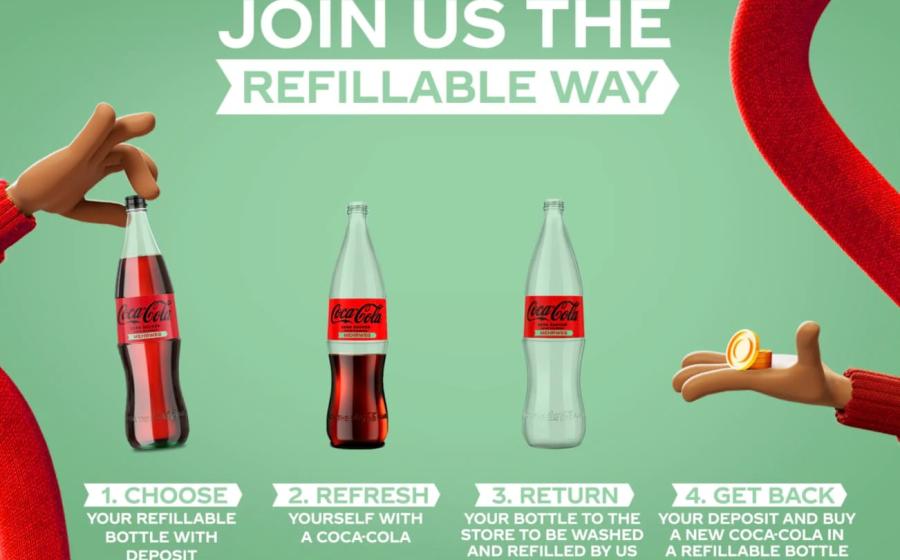

The Coca-Cola System is accelerating the global expansion of refillable glass and PET bottles, combining standardized packaging formats, local collection infrastructure and consumer engagement to build reusable packaging systems across markets.
The Coca-Cola Company is stepping up its global focus on refillable and reusable beverage packaging, as the company and its bottling partners expand returnable glass and PET bottle systems across multiple markets.
According to Coca-Cola, refillable packaging accounted for 14% of its total beverage volume in 2025, highlighting the growing role of reuse within the company’s packaging portfolio. The company says the expansion is being driven by investments in local infrastructure, standardized bottle formats and consumer-facing campaigns.
Building a Global Refillables Model
Unlike single-use packaging, refillable bottles are designed to be collected, cleaned and put back into circulation multiple times. Coca-Cola says the actual number of reuse cycles depends on factors including the packaging material, design and operating conditions.
A key element of its strategy is the development of standardized “universal bottles” that can be used across multiple beverage brands. This approach can simplify collection, cleaning, inspection and refilling while allowing bottlers to operate a more efficient reusable packaging system.
In Latin America, for example, bottling partner Arca Continental invested US$23 million in a new line in Guayaquil, Ecuador, to produce universal bottles and family-size returnable packaging. The line can process up to 400 bottles per minute while incorporating improvements in water and energy efficiency.
France Expands Refillable Packaging Across the Portfolio
France provides another example of how Coca-Cola is scaling reuse through dedicated infrastructure.
Coca-Cola Europacific Partners (CCEP) France became the first soft-drink supplier in the country to offer its full beverage portfolio in refillable bottles, including Coca-Cola, Sprite, Fanta and Fuze Tea.
The bottles are collected, cleaned and refilled at CCEP's facility in Grigny near Paris. In 2025, the facility inaugurated a modernized glass-bottle line following an investment of €146 million to expand and upgrade its capacity.
The development demonstrates an important point for the packaging industry: scaling reuse requires more than simply designing a reusable bottle. It requires an integrated ecosystem covering collection, reverse logistics, inspection, washing, refilling, distribution and consumer participation.
Local Infrastructure, Global Ambition
Coca-Cola's refillable packaging strategy is being adapted to local market conditions rather than applying a single global model.
Recent developments include:
- Introduction of universal refillable bottles in Germany, South Africa and Vietnam
- A new glass-bottle production line from Coca-Cola's Thailand bottling partner
- A €12 million expansion of a refillable packaging line in Austria by Coca-Cola HBC
- Consumer campaigns in Brazil and Bolivia promoting refillable packaging
These initiatives demonstrate how reuse systems can require significant investments in both packaging assets and supporting infrastructure.
Why Refillable Packaging Matters
The move toward refillable packaging is becoming increasingly relevant as brands, regulators and packaging companies look beyond recycling toward reuse and circularity.
A recyclable bottle still requires collection, sorting and recycling infrastructure at the end of its life. A refillable bottle introduces another potential pathway: keeping the packaging in circulation for multiple use cycles before it is eventually recycled.
However, reuse also presents its own operational challenges. Coca-Cola notes that refillable packaging requires local collection infrastructure, upfront investment and ongoing participation from customers and consumers.
This makes the success of refillable packaging dependent not only on bottle design but also on the economics and efficiency of the complete system.
From Packaging to Packaging Systems
For the packaging industry, Coca-Cola's latest developments highlight a broader shift in how packaging sustainability is being approached.
The focus is increasingly moving from “What material is the package made from?” to “How does the entire packaging system operate?”
Standardization, reverse logistics, washing infrastructure, deposit or return mechanisms, bottle durability, tracking and consumer behavior all become critical components of a successful reuse model.
Coca-Cola's continued investment suggests that refillable packaging is being treated not simply as an alternative bottle format, but as a long-term packaging system requiring coordinated investment across the value chain.
As brands face increasing pressure to reduce packaging waste and improve circularity, the expansion of refillable glass and PET could become an increasingly important part of the global beverage packaging landscape.