




Naked packaging, broadly understood as selling products with little or no conventional packaging, has evolved from a distinctive approach pioneered by brands such as Lush into one of several strategies being explored to reduce packaging use. The concept is particularly visible in personal care, where solid formats can eliminate the need for bottles altogether.
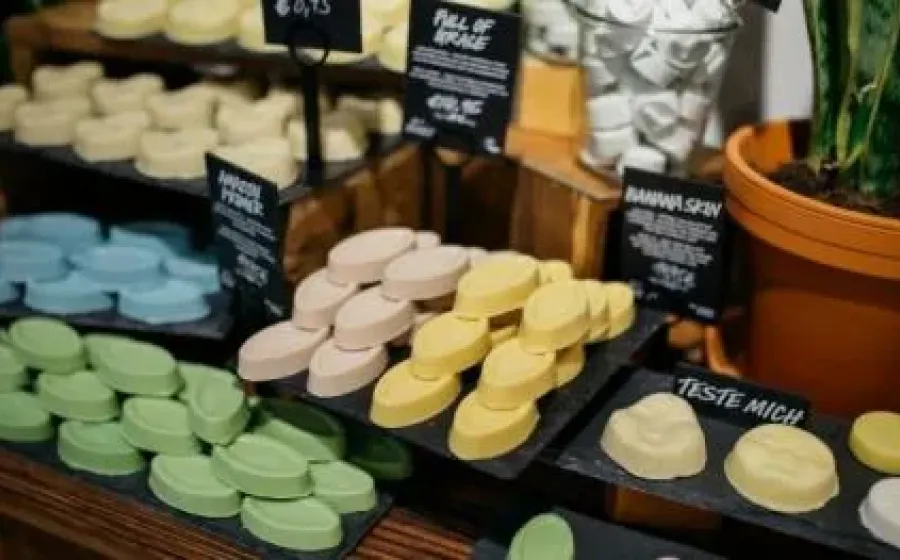
One of the best-known examples began in the late 1980s. Lush co-founder Mo Constantine and cosmetic chemist Stan Krysztal developed the solid shampoo bar, creating a concentrated format that could be sold without the plastic bottle used for conventional liquid shampoo. Lush describes Mo Constantine as having begun making naked products unintentionally before deliberately taking the concept further.
The idea gained wider public attention through Lush's campaigns around packaging. In 2006, Lush said that customers choosing naked shampoo bars instead of packaged liquid alternatives had saved 3 million plastic bottles from being made, transported and disposed of. On 12 July 2007, Lush staff across 55 UK cities also appeared in stores wearing little more than branded aprons as part of a campaign against excessive product packaging. The campaign helped turn packaging reduction into a highly visible part of the brand's identity.
From there, naked packaging developed along several paths. The first is elimination: removing the container entirely where the product format allows it. Lush has taken this approach particularly far, including through dedicated Naked stores in Manchester, Milan and Berlin, where products were presented without conventional packaging.
The economics of eliminating packaging can also be significant. Lush has stated that packaging can account for around 40–50% of the cost of some products, according to cosmetic scientist and Lush product inventor Daniel Campbell. The company says that eliminating packaging can instead allow more of the product's cost to be directed toward ingredients. This is a company-specific claim rather than a universal packaging-cost benchmark, but it illustrates one reason brands may consider packaging elimination alongside its environmental benefits.
The second path is label reduction: retaining a container while eliminating a separate paper or plastic label. Shell Helix, for example, has been associated with a label-less lubricant bottle that incorporates graphics directly into the molded container. This approach can reduce the number of separate packaging components while preserving brand identification on the pack.
However, label-less packaging is not the same as information-free packaging. Packaging for regulated products may still need to communicate mandatory product, safety, legal or traceability information. As a result, eliminating a label can require manufacturers to rethink how essential information is incorporated into the pack or communicated through other compliant channels.
Regulation is also increasing pressure on companies to reconsider how packaging is designed and used. The European Union's Packaging and Packaging Waste Regulation (PPWR), Regulation (EU) 2025/40, introduces a range of requirements covering packaging reduction, recyclability and reuse. From 1 January 2030, economic operators using specified forms of transport packaging, or sales packaging used for transport, will generally be required to ensure that at least 40% of such packaging is reusable within a reuse system. The regulation also establishes different requirements for particular supply-chain scenarios and provides exemptions for certain packaging formats and uses.
The PPWR therefore does not specifically require brands to adopt naked packaging. Instead, it creates a broader regulatory environment in which packaging elimination, reuse, refill and material efficiency can become increasingly important design considerations.
For packaging developers, the shift toward naked and near-naked formats creates several technical challenges. Eliminating a bottle may require a concentrated or solid product format. Removing a label can shift graphic information into the mold itself, increasing the importance of embossing, tooling and material selection. Where packaging remains necessary, designers may also need to balance reduced material use with protection, shelf visibility, regulatory information and recyclability.
Naked packaging is therefore less a single packaging format than a design philosophy: use packaging only where it serves a necessary function, and look for ways to eliminate or simplify components that do not. Lush's decades-long experimentation with packaging-free products demonstrates one end of this spectrum, while label-less and highly simplified packs represent another.
As packaging regulation becomes more focused on reduction, reuse and circularity, these approaches could become increasingly relevant to packaging R&D. The challenge for brands will be to determine where packaging can genuinely be removed or simplified without compromising product protection, safety, functionality, compliance or the consumer experience.
Sources
- Lush, “Shampoo Bars – The Naked Revolution.” https://www.lush.com/cz/cs/a/shampoo-bars-naked-revolution
- Lush, “Packaging free cosmetics.” https://www.lush.com/hu/hu/a/packaging-free-cosmetics
- Lush, “What's In Your LUSH Parcel?” https://www.lush.com/hu/hu/a/whats-in-your-parcel
- Packaging World, “Lush goes all the way.”
- Plastics Engineering, “The Art of Undressing: How Naked Packaging Unveils Sustainability.”
- European Union, Regulation (EU) 2025/40, Packaging and Packaging Waste Regulation (PPWR), Article 29. https://eur-lex.europa.eu/eli/reg/2025/40/oj