




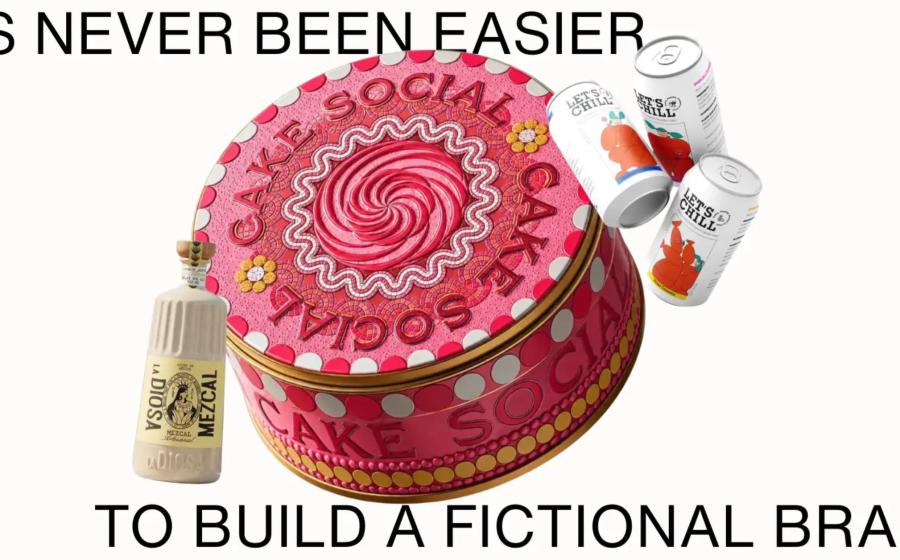

The barrier between real and fictional brands is becoming increasingly difficult to see, as AI and accessible digital tools make it possible to create highly developed brand identities, packaging and visual worlds without the traditional investment of time, money and production resources.
For decades, creating a convincing consumer brand required a substantial team and considerable investment. Strategy, naming, identity, packaging design, photography, website development and brand communication typically involved multiple specialists working across several stages of development.
Today, that process is changing rapidly.
The latest trend highlighted by DIELINE is the growing volume of fictional and speculative brands appearing online, many of which look remarkably similar to commercially launched products.
The Rise of the “Almost Real” Brand
Concept brands are nothing new. Designers, agencies and students have long created fictional products to demonstrate creative thinking or explore what a future brand could look like.
What has changed is the speed, accessibility and sophistication of the process.
According to DIELINE, the volume of concept work has increased significantly, while the traditional clues that once made fictional packaging easy to identify are becoming less obvious. A decade ago, a concept package might lack practical details such as barcodes, regulatory information or other production elements. Today, increasingly sophisticated digital tools can create visuals that appear much closer to commercially produced packaging.
This creates a fascinating new environment for packaging designers and brand owners.
AI Is Compressing the Brand-Building Process
Artificial intelligence is rapidly reducing the amount of time and resources required to visualize a complete brand ecosystem.
A designer can now explore:
- Brand names and positioning
- Visual identities
- Packaging structures
- Labels and graphics
- Product photography
- Retail environments
- Advertising campaigns
- Websites and digital experiences
Instead of waiting weeks to move from an idea to a visual prototype, teams can explore dozens of directions in a much shorter timeframe.
The result is not simply faster design.
It is a fundamental change in how ideas are explored, tested and communicated.
Packaging Becomes a Storytelling Tool
For the packaging industry, this trend is particularly significant.
A fictional brand can now be presented with the same visual sophistication as an established consumer product. Packaging can be shown on supermarket shelves, in kitchens, bathrooms or retail environments before the product ever exists physically.
This makes packaging increasingly powerful as a visual prototyping and storytelling tool.
A concept that previously existed as a sketch or mood board can now become an apparently finished product experience.
For brand owners, this can make early-stage concept development more tangible. Teams can visualize how an idea might look across multiple SKUs, formats and touchpoints before committing to physical development.
But There Is a New Problem: What Is Real?
The growing realism of AI-generated brand and packaging imagery introduces an important challenge: authenticity.
DIELINE points out that even experienced observers can increasingly find it difficult to distinguish fictional brands from real ones. Traditional signals such as missing barcodes, regulatory information or production details are becoming less reliable as visual generation tools become more sophisticated.
This creates implications beyond design.
Consumers may increasingly encounter packaging imagery online that looks like a genuine commercial product but represents something that does not actually exist.
For packaging professionals, this raises questions around brand authenticity, intellectual property, consumer trust and responsible use of AI-generated content.
From Concept Design to Pre-Production Visualization
There is also a significant opportunity hidden within this development.
AI-generated packaging should not necessarily be viewed as a replacement for professional packaging development. Instead, it can become a powerful front-end innovation tool.
Design teams can use AI to rapidly explore:
Concept → Visualisation → Consumer reaction → Refinement → Physical prototype → Production
This can potentially reduce the number of physical prototypes required during early-stage development and allow teams to test more creative directions before selecting concepts for technical development.
However, digital realism should not be confused with technical feasibility.
A beautiful AI-generated package may still have no viable manufacturing process, appropriate barrier properties, sealing performance, regulatory compliance, filling compatibility or supply-chain economics.
That distinction will remain critical.
The Packaging Designer’s Role Is Changing
As AI makes visual creation easier, the value of packaging professionals is likely to move increasingly toward strategy, technical knowledge, judgement and execution.
Generating an attractive pack may become relatively easy.
Knowing whether that pack can actually be manufactured, filled, transported, opened, recycled, regulated and commercially scaled is considerably more complex.
This could make collaboration between creative designers, packaging technologists, engineers, marketers and manufacturers even more important.
The Next Era of Packaging Innovation
The emergence of highly realistic fictional brands signals something bigger than a new design trend.
It represents the beginning of a world where the cost of imagining a product is approaching zero.
Brands can explore more ideas. Designers can visualize more possibilities. Packaging teams can communicate concepts earlier. Consumers can experience products virtually before they exist.
But as the distinction between concept and reality becomes increasingly blurred, the industry will also need stronger standards around transparency and authenticity.
The future of packaging design may therefore not be about AI versus human creativity.
Instead, it could be about combining AI's ability to generate possibilities with human expertise to determine which possibilities are worth making real.
Source: DIELINE, Shelf Life 127: It’s Never Been Easier to Build a Fictional Brand, September 14, 2026.