




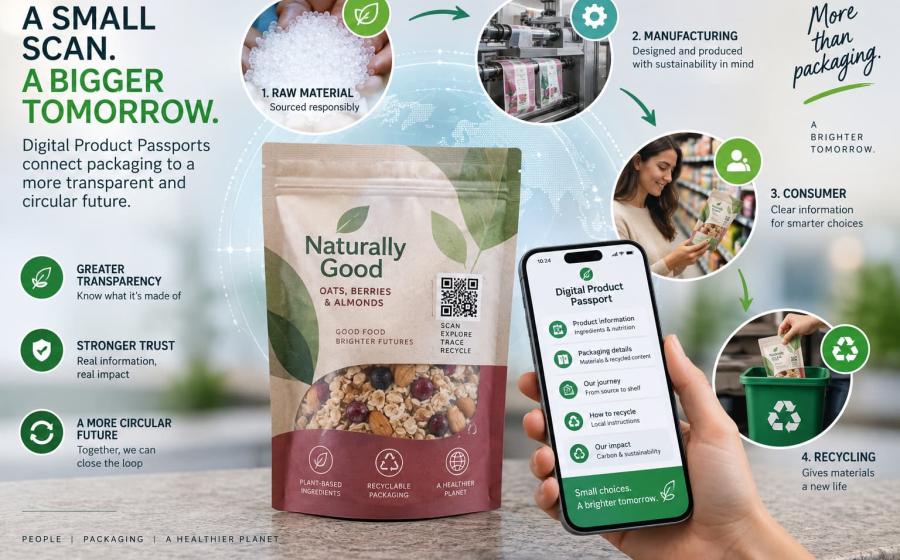

Europe's regulatory push is accelerating the conversation
The European Union is playing an important role in pushing product-level sustainability information forward.
The Ecodesign for Sustainable Products Regulation (ESPR) establishes the framework for Digital Product Passports across relevant product categories.
At the same time, the Packaging and Packaging Waste Regulation (PPWR) is reshaping the packaging landscape around recyclability, recycled content, packaging waste reduction and sustainability requirements.
For companies supplying the European market, these developments make digital product information increasingly difficult to ignore.And the implications could extend beyond Europe.
Global brands rarely maintain completely separate packaging ecosystems for every market. Changes introduced to meet European requirements can influence packaging design and supply chains internationally.
But there is a problem: data
Here's the less exciting part of the DPP story.
Creating the QR code is easy.
Creating reliable information behind it is much harder.
Someone needs to collect the data.
Someone needs to verify it.
Someone needs to update it.
And someone needs to decide who is allowed to access it.
Consider a packaging structure involving a resin supplier, adhesive supplier, ink manufacturer, film producer, converter and brand owner.
Who owns the final data?
How is it verified?
How does each participant share information?
And how can companies provide transparency without exposing commercially sensitive information?
These are not just technology questions.
They are supply-chain and governance questions.
Packaging professionals will need to become data professionals too
The packaging industry already combines chemistry, engineering, printing, converting, logistics and manufacturing.
DPPs introduce another layer:
Data management.
Packaging companies may increasingly need systems capable of capturing and exchanging information across the value chain.
This could create new opportunities for collaboration between:
Packaging companies + technology providers + brands + recyclers + material suppliers + regulators
The packaging ecosystem of tomorrow may therefore look very different from the one we know today.
Will consumers actually use Digital Product Passports?
This is probably the biggest question.
Consumers already encounter QR codes everywhere.
Another QR code on a package won't automatically create engagement.
The experience needs to provide something useful.
If scanning the package produces pages of technical information, most people won't bother.
But if it immediately answers:
"How do I recycle this?"
that's useful.
If it tells someone:
"This package contains recycled content."
that's meaningful.
If it explains:
"Separate these two components before disposal."
that's actionable.
The winning DPP experience will therefore not necessarily be the one with the most information.
It will be the one that provides the right information at the right moment.
The future of packaging may be physical and digital
For more than a century, packaging has performed a handful of fundamental jobs:
Protect.
Contain.
Transport.
Communicate.
The next generation could add another:
Connect.
A package could have a physical layer made from paper, plastic, glass or metal and a digital layer containing information about its identity and lifecycle.
That combination could fundamentally change how we think about packaging.
The package would no longer be simply a container.
It could become a data carrier within the circular economy.
What should packaging companies do now?
The DPP ecosystem is still developing, so companies don't necessarily need to have every answer today.
But they can start preparing.
1. Understand your packaging data
Know exactly what information exists about your packaging materials, components and suppliers.
2. Map the value chain
Identify where sustainability and material data is created, stored and transferred.
3. Improve data quality
Inconsistent or incomplete information will become increasingly problematic as digital traceability expands.
4. Work with suppliers
DPPs will require collaboration. Start discussing data requirements with material suppliers, converters, printers and other partners.
5. Think beyond compliance
The companies that see DPPs only as a regulatory requirement may miss their bigger potential.
The real opportunity could be better traceability, consumer engagement and circularity.
The package that tells its own story
The most interesting thing about Digital Product Passports isn't the technology.
It is what the technology could allow packaging to become.
For decades, we have asked packaging to protect products.
We have asked it to look attractive.
We have asked it to be cheaper.
We have asked it to use less material.
We have asked it to become recyclable.
Now we may be asking it to tell us what happens next.
Imagine a future where a package can effectively say:
"This is what I am.
This is what I'm made from.
This is where my materials came from.
This is how I was produced.
This is how you should dispose of me.
And this is where I can go next."
That is much more than a QR code.
It is a shift from packaging as a physical object to packaging as a physical + digital system.
And if the industry gets it right, Digital Product Passports could help make the circular economy not just more transparent—but more practical.
The future of packaging may not simply be smarter materials. It may be smarter information.