



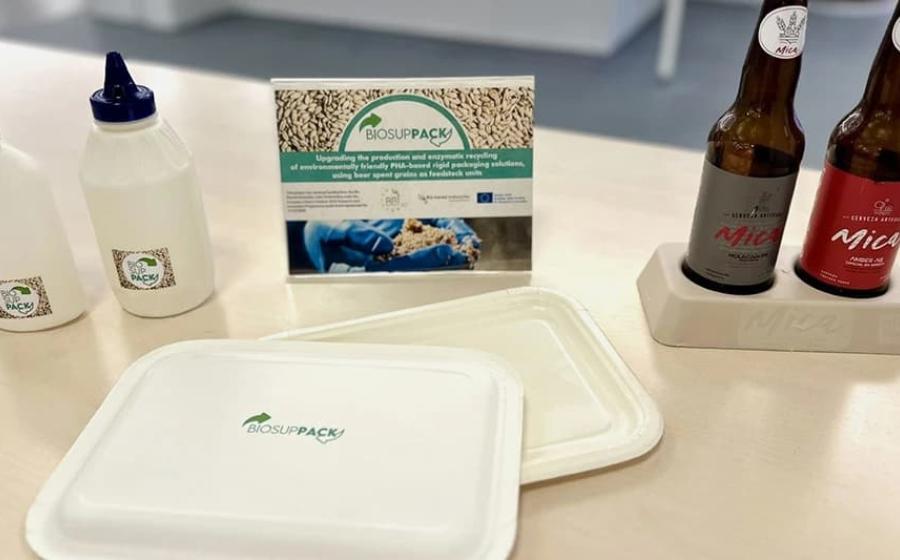

Aimplas, the Plastics Technology Centre based in Valencia, Spain, has announced that brewery waste can be transformed into high-performance bioplastics for sustainable packaging through its European Union-funded BioSupPack project.
18 partners have joined efforts to transform brewery waste into high‑value packaging materials and to enable the recycling of this packaging through technologies.
The results of the BioSupPack project are now available for industry adoption, offering solutions for biopolymer producers, biorefineries, packaging manufacturers and brand owners in the food, cosmetics and consumer goods sectors.
The consortium has developed and validated polyhydroxyalkanoate (PHA and PHB) materials and production processes that offer viable alternatives to fossil-based plastics while supporting compliance with the EU Packaging and Packaging Waste Regulation (PPWR).
The project is funded by the Circular Bio-based Europe Joint Undertaking (CBE JU, formerly BBI JU) with 7.6 million euros under the European Union’s Horizon 2020 research and innovation programme (Grant Agreement No. 101023685).
“BioSupPack has demonstrated that we can create a true circular economy by turning brewery waste into valuable packaging materials and by recycling the packaging waste through innovative recycling technologies like enzymatic recycling,” says Rosa González Leyba, Aimplas project coordinator. “Our consortium has successfully scaled up innovative biorefinery processes and developed biobased materials for rigid packaging for food and nonfood applications, obtaining packaging prototypes which are very close to the current counterparts on the market.”
At a demonstrative scale and in real operational environments, BioSupPack has developed and validated key innovations that address critical challenges in the packaging industry, including a scalable bioprocess that converts brewery spent grains into high-purity PHB through a plasma pretreatment and microbial fermentation. This innovation transforms a low-value waste stream into a functional biopolymer while creating industrial symbiosis between breweries and bioplastics producers.
The project has developed PHA plastisol coatings that are 99 percent biobased and fully biodegradable. These coatings can be applied to paperboard as alternatives to polyethylene (PE) coatings, as well as to textiles as replacements for PVC.
The consortium has created industrially compostable, fiber-based packaging with barrier properties comparable to fossil-based plastics. Applications include ice cream cups and trays. This solution enables companies to meet sustainability goals while offering dual end-of-life options.
Sabiomaterials, Italy, has developed PHB-based materials optimized for rigid packaging applications such as bottles and displays for retail applications. ILAB has obtained bottles for dressings and personal care products and Aimplas has developed and produced a beer bottle display for the retail sector.
The sorting prototype for the packaging waste from IRIS will allow the recovery of the new packaging waste streams for the subsequent enzymatic recycling, which the consortium says has shown to be an effective end-of-life solution for these packaging materials, due to the development of novel selective enzymes.
BioSupPack says its innovations directly address the packaging industry’s transformation driven by the PPWR. With the requirement that all packaging must be recyclable by 2030 and growing demands for sustainability from consumers and regulators, the project’s results provide pathways for the industry to transition from fossil-based to biobased, circular packaging solutions. The technologies developed can be integrated into existing manufacturing infrastructure, reducing technical and economic barriers to adoption.