




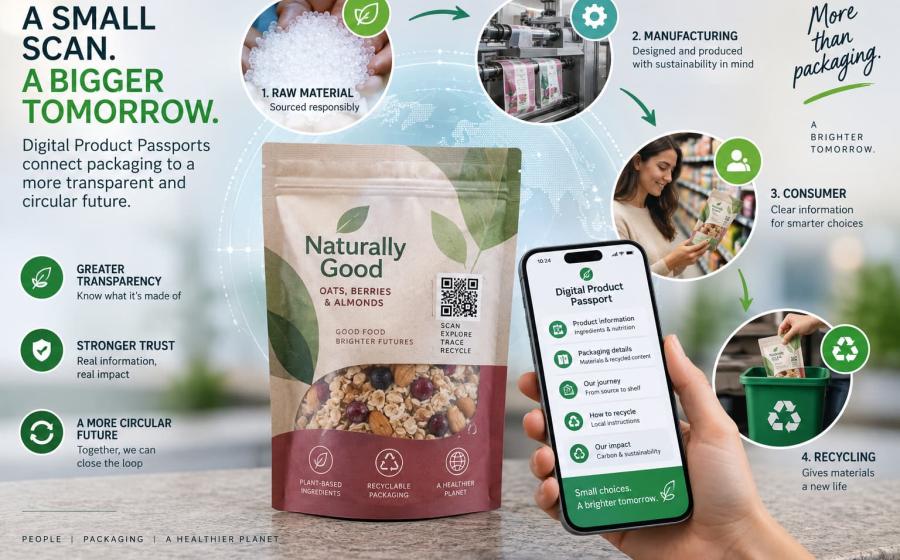

Packaging is getting smarter. And the next big change may not be another material, coating or printing technology—it could be data.
For years, the packaging industry has focused on making packaging lighter, stronger, safer and more recyclable.
Now another transformation is taking shape.
What if packaging could tell us exactly what it is, where its materials came from, how it should be recycled and what happens to it after use?
That is the idea behind the Digital Product Passport (DPP).
While the concept extends well beyond packaging, it could become particularly important for an industry where material composition, recyclability, recycled content and end-of-life information are becoming increasingly important.
And for packaging professionals, this isn't simply a conversation about putting another QR code on a pack.
It is potentially about creating a digital identity for packaging.
What is a Digital Product Passport?
A Digital Product Passport is essentially a digital record connected to a physical product through a data carrier such as a QR code or another machine-readable identifier.
For packaging, that digital record could contain information such as:
- Material composition
- Recycled content
- Packaging weight
- Material origin
- Recycling instructions
- Reuse information
- Relevant certifications
- Environmental information
- Supply-chain information
- Regulatory and compliance data
The physical package doesn't need to carry all this information.
Instead, the package provides the gateway to the information.
And that simple idea could have a surprisingly large impact.
Why does packaging need a digital identity?
Walk through any supermarket and look at the packaging around you.
A pouch may appear to be made from plastic.
A tray may look like paper.
A bottle may look straightforward.
But behind that appearance can be a much more complicated combination of materials, coatings, adhesives, inks and barrier layers.
For consumers, that complexity can make recycling confusing.
For recyclers, it can make material identification and sorting more difficult.
This creates an important gap between:
"This package looks recyclable."
and
"This package can actually be identified, collected and recycled through the appropriate system."
Digital Product Passports could help close that information gap.
From recycling symbols to real recycling instructions
Packaging already contains recycling symbols.But symbols alone don't always answer the questions consumers actually have.
Do I remove the cap?
Does the sleeve need to be separated?
Can this flexible pouch go into my recycling bin?
What should I do with this tray?
A Digital Product Passport could provide more detailed and location-relevant information.Instead of trying to interpret a collection of symbols, consumers could scan the package and receive simple instructions.That could make the difference between information being available and information actually being used.
And that distinction matters.
The QR code is only the beginning
It would be easy to describe DPPs as simply "QR codes on packaging."
But that misses the real opportunity.
The QR code or another data carrier is only the entry point.
The real value lies in the information infrastructure behind it.
Consider a typical packaging journey:
Raw material supplier → packaging manufacturer → converter → brand owner → retailer → consumer → collection system → recycler
Today, information can become fragmented as packaging moves through this chain.
DPPs could help create a digital thread connecting different stages of that journey.
For example, information about the material structure could be generated upstream, enriched by packaging manufacturers and made accessible to downstream stakeholders.
The package effectively becomes part of a connected data ecosystem.
What does this mean for packaging manufacturers?
For converters and packaging manufacturers, the emergence of DPPs could mean that sustainability information becomes an increasingly important part of the product specification.
It may no longer be enough to know:
What material is this?
Companies may increasingly need to know:
What data do we have about this material?
That could include information about:
- Material origin
- Composition
- Recycled content
- Recyclability
- Manufacturing processes
- Relevant certifications
- Carbon-related information
- End-of-life pathways
This creates a new challenge for an industry that has traditionally been highly physical and engineering-driven.
Packaging is becoming a data business too.
A major opportunity for brands
For brands, DPPs could go beyond regulatory compliance.
They could create a new communication channel between the brand and the consumer.
A single digital identity could potentially provide access to:
Product information + packaging information + sustainability information + recycling guidance
It could also support applications such as product authentication, traceability, recalls and consumer engagement.
Imagine buying a product and scanning the package to discover not just information about the product, but also:
"This pack contains 40% recycled material."
"Remove the lid before recycling."
"The paper component can be recycled separately."
Suddenly, packaging is no longer silent once the product has been purchased.
It becomes an interactive information carrier.
Why recyclers could be among the biggest beneficiaries
Perhaps the most interesting application of DPPs lies further down the value chain.
Recycling depends heavily on knowing what material is actually entering the system.
Visual identification can only go so far.
Digital information could potentially help sorting and recycling systems identify packaging more accurately.
In the future, this could create opportunities for digital systems and automated sorting technologies to work together.
A package could potentially be identified physically and digitally, allowing the recycling system to determine the most appropriate pathway.
That could help move the industry toward a model where packaging isn't simply classified as "waste."
Instead, it is recognised as a recoverable material with a known history and composition.