




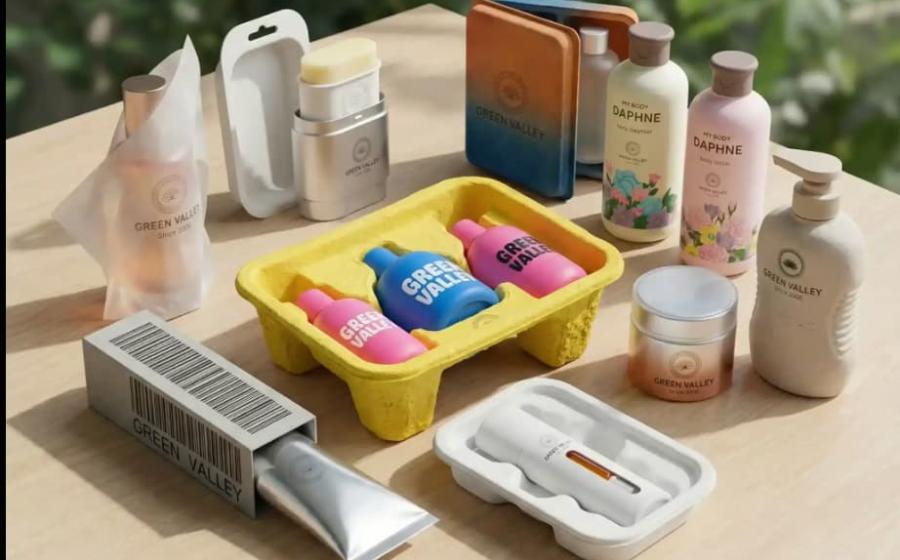

Plastic packaging innovation is evolving beyond simply creating a new bottle or container. Today’s most interesting developments focus on three important areas: improving the consumer experience, simplifying packaging for recyclability, and creating stronger visual and tactile brand differentiation.
From precision dispensing systems and ergonomic closures to mono-material pumps, airless packs and decoration integrated directly into the package, these innovations demonstrate how packaging is becoming smarter, more functional and more distinctive.
Here are 18 innovations shaping the next generation of plastic packaging.
1. Rotary Dropper Bottle: Precision Through a Simple Twist
Traditional droppers often rely on squeezing a rubber bulb to draw and dispense liquid. The Rotary Dropper Bottle introduces a more intuitive mechanism, allowing users to draw and dispense a measured dose simply by twisting the cap.
The controlled dispensing experience makes this format particularly relevant for serums, facial oils and other high-value skincare formulations, where dosage accuracy and premium user interaction are important.
2. Flexible Silicone Massage Applicator Tube
Packaging is increasingly becoming part of the product experience. The Flexible Silicone Massage Applicator Tube replaces conventional roller-ball applicators with a soft and pliable silicone head.
Designed for direct-to-skin application, the applicator can provide a smoother and more sensorial experience while allowing targeted product delivery. It is particularly suited to eye creams, serums and specialised skincare treatments.
3. Aluminum Tube with an Integrated Flip-Top Cap
The familiar aluminum tube is receiving a convenience upgrade.
By integrating a hinged flip-top closure, this format eliminates the need to completely remove and replace a traditional screw cap. The result is quicker, easier and potentially more convenient one-handed dispensing.
The combination of an aluminum body with an integrated flip-top closure makes it suitable for skincare, colour cosmetics and personal care applications, where product protection and premium aesthetics are both important.
4. Refillable Airless Bottle
Airless packaging is valued for its ability to help protect sensitive formulations from exposure to air. The Refillable Airless Bottle takes this concept further by incorporating a replaceable inner cartridge or refill system.
Instead of discarding the entire package, consumers can reuse the outer component and replace only the product-containing element.
This approach is particularly relevant for premium skincare, anti-aging formulations and active-rich products, where airless protection and sustainability can work together.
5. Mono-Material PP Pump
Conventional pumps often contain a combination of plastic resins and metal springs, making recycling more complicated.
The Mono-Material PP Pump addresses this challenge by using polypropylene throughout the pump structure, including internal components that would traditionally be made from different materials.
By simplifying the material composition, the innovation supports a more straightforward approach to material sorting and recycling while maintaining the functionality expected from lotion and treatment pumps.
6. Mono-Material Airless Bottle
Airless packaging has traditionally involved multiple materials and complex components. A mono-material approach aims to simplify this construction by creating an airless system based on a single resin family.
The innovation demonstrates an important direction for the industry: maintaining high-performance packaging functions while reducing material complexity.
For skincare products containing sensitive or active ingredients, this could provide a balance between formulation protection and improved end-of-life considerations.
7. All-Plastic Precompression Trigger Sprayer
A precompression trigger sprayer builds pressure before releasing the formulation, helping deliver a more consistent and complete spray.
By combining this mechanism with a fully plastic, metal-free construction, the All-Plastic Precompression Trigger Sprayer addresses two important requirements: dispensing performance and material simplification.
Potential applications include home care cleaners, personal care products and industrial formulations where consistent spray quality is essential.
8. All-Plastic Fine Mist Sprayer
Fine mist pumps are widely used across beauty and personal care, but conventional designs often incorporate metal springs.
The All-Plastic Fine Mist Sprayer removes this metal component while continuing to deliver a soft and even spray.
This innovation reflects the growing effort to redesign familiar packaging components around mono-material or simplified-material principles without compromising the consumer experience.
9. Wide-Spray Fine Mist Sprayer
The Wide-Spray Fine Mist Sprayer focuses on improving product coverage.
By dispersing the formulation over a broader area with each actuation, it can make application faster and more convenient. This is particularly valuable for products such as body mists, sunscreens, haircare products and home care formulations.
Sometimes innovation does not require an entirely new packaging format. Improving the efficiency and experience of an existing mechanism can be equally impactful.
10. Tamper-Evident Disc-Top Cap
Consumer safety and product integrity are increasingly important packaging considerations.
The Tamper-Evident Disc-Top Cap combines the convenience of a standard press-to-open disc-top closure with an integrated feature that provides visible evidence of whether the package has been opened.
The format could be particularly useful for personal care, home care and pharmaceutical-adjacent applications, where trust and convenience need to work together.
11. One-Touch Side-Release Cap
Opening a conventional closure can sometimes require two hands. The One-Touch Side-Release Cap changes this interaction by incorporating a side-mounted button that releases the cap with a single press.
The design focuses on one-handed convenience and ergonomic interaction, making it suitable for applications such as sunscreens, lotions and portable personal care products.
It demonstrates how small structural changes can significantly improve the consumer experience.
12. Velvet-Texture Multi-Layer PE Tube
Texture is becoming an increasingly important part of packaging design.
The Velvet-Texture PE Tube combines a soft, matte surface with a multi-layer structure designed to support product protection. The result is packaging that aims to deliver both functional performance and a premium tactile experience.
For skincare and personal care brands, tactile packaging can play an important role in differentiating the product before the consumer even uses it.
13. Tri-Colour Gradient Injection-Moulded PET Bottle
Premium decoration often requires secondary processes such as spraying or coating. The Tri-Colour Gradient Injection-Moulded PET Bottle takes a different approach by creating the colour gradient directly during the moulding process.
The result is a visually striking transition between colours without relying on an additional decoration layer.
This innovation is particularly interesting because it combines shelf differentiation with manufacturing simplification, while retaining the PET-based bottle structure.
14. Thumb-Activated Trigger Sprayer
Ergonomics can significantly influence how consumers perceive a package.
The Thumb-Activated Trigger Sprayer moves the actuation point to the top of the package, allowing users to dispense the product through a downward thumb press rather than a conventional finger-pull trigger.
This approach can reduce hand fatigue during repeated use and provide a more controlled dispensing experience. The format may also incorporate post-consumer recycled content, adding another dimension to its sustainability profile.
15. Clear PET Aerosol Bottle
Traditional aerosol packaging is commonly associated with opaque metal cans. A clear PET aerosol bottle introduces a different visual experience by allowing consumers to see the product or fill level.
The format is designed to work with standard aerosol valves and actuators, potentially allowing brands to explore transparent aerosol packaging without completely redesigning their dispensing systems.
For personal care and home care brands, visibility can become an additional element of product communication and shelf differentiation.
16. Large-Diameter D75 Plastic Tube
Increasing the diameter of a tube can create new possibilities for both capacity and decoration.
The D75 large-diameter tube provides a broader package surface, giving brands more space for impactful graphics and stronger shelf presence. It can also accommodate higher-volume products and thicker formulations.
This format is particularly relevant for body care, skincare and other personal care products where packaging needs to combine functionality with visual impact.
17. Glossy Pearlescent Spray Decoration
Packaging decoration continues to play a critical role in communicating premium quality.
Glossy Pearlescent Spray Decoration creates a luminous, pearl-like finish on plastic bottles, jars and closures. The visual effect changes subtly under light, helping create a more luxurious appearance.
For prestige skincare, colour cosmetics and premium personal care, such finishes can help elevate perceived product value without changing the fundamental packaging structure.
18. PETG Jelly-Bubble Cap
The PETG Jelly-Bubble Cap brings a playful and highly visual approach to closure design.
Its transparent outer shell and double-wall construction create a glossy, rounded appearance that gives the package a distinctive tactile and visual identity.
Available across multiple diameters, the concept can be adapted for skincare, lip care and colour cosmetics, where packaging itself often plays a major role in attracting consumers.
The Bigger Innovation Trend
Looking across these developments, three clear themes emerge.
1. Packaging Is Becoming More Experiential
Consumers are interacting more directly with packaging through twisting, pressing, spraying, massaging and one-touch opening.
The package is no longer simply a container. It is increasingly becoming part of the product experience.
2. Material Simplification Is Driving Sustainable Design
Mono-material pumps, all-plastic sprayers and simplified airless systems demonstrate the industry's effort to address one of packaging's long-standing challenges: complex combinations of materials.
Designing components with fewer material types can potentially make sorting and recycling easier, depending on local recycling infrastructure and the complete packaging system.
3. Decoration Is Moving Into the Structure of the Pack
From moulded colour gradients to tactile textures and transparent double-wall closures, brands are exploring ways to create stronger shelf differentiation through the packaging structure itself.
This can reduce dependence on separate labels or secondary decorative elements while opening new possibilities for visual identity.
Innovation Is in the Details
The future of plastic packaging innovation may not always involve completely reinventing the package.
Sometimes, the biggest opportunities lie in improving the details: a more intuitive cap, a better spray pattern, a simplified material structure, a refillable system or a surface that changes how consumers perceive the product.
These 18 concepts highlight a broader shift in the packaging industry. Innovation is increasingly focused on creating packaging that is easier to use, more conscious of material design and more distinctive on the shelf.
For brands, packaging developers and material suppliers, the opportunity lies in combining these priorities rather than treating them separately. The most successful next-generation packs will be those that deliver performance, sustainability and consumer experience in one integrated solution.