



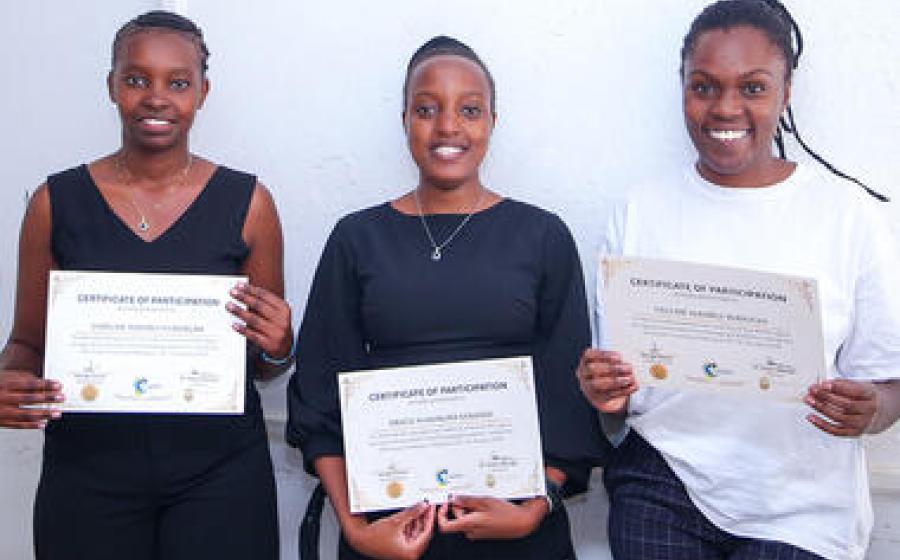

A dynamic student trio from the Technical University of Kenya (TUK) has devised an innovative way to tackle plastic waste pollution while also addressing climate change.
The final-year students – Grace Mwangi, Sherline Wambui and Pauline Wambui – have developed an environmentally friendly frozen food packaging material that can detect food spoilage and also includes an antimicrobial component that helps extend the shelf life of food products by reducing microbial activity.
Mwangi and Sherline Wambui are students of technology in industrial chemistry and Pauline Wambui is pursuing a technology in applied biology qualification.
The biodegradable packaging material, called EcoWrap, is mainly made from sugarcane waste (bagasse) combined with red cabbage or hibiscus flowers. It is pH-responsive, enabling it to detect when food is rotting, while its antimicrobial properties suppress bacterial activity in foodstuffs, allowing them to last longer on the shelf.
Its antimicrobial component may be extracted from mushrooms, which helps increase the food’s shelf life.
“While our main aim of the project was to help eliminate usage of non-biodegradable synthetic polymers that contribute to plastic pollution, we realised we could also incorporate components that enable detection of spoilage in food as well as lengthen their shelf life,” explained Mwangi.
“All the raw materials used in our product are biodegradable as they are made from plant extracts. This means that, once the wraps have been used and disposed of, they will decompose naturally in the environment,” Mwangi told University World News.
How does it detect rotting food?
According to the trio, their packaging material is made up of four layers:
• Layer one – made from sugarcane extract.
• Layer two – made from mushroom extract.
• Layer three – the pH indicator layer.
• Layer four – the food contact layer, which is porous to allow diffusion of gases to the pH indicator layer.
“When the gases – that is, volatile nitrogen gases (ammonia) – produced from food spoilage, diffuse through the food contact layer, the colour of the indicator changes, indicating spoilage,” Mwangi said.
This spoilage detection could enable both producers and consumers to avoid financial losses from purchasing bad food.
In a country where access to cold storage facilities such as refrigerators is still a luxury, this material could become an important accessory.
Sustainability and environmental impact
The project’s use of sugarcane waste as its main raw material makes it sustainable and environmentally friendly. Hibiscus flowers are also inexpensive and contain high quantities of anthocyanins.
“The bioplastics can be extracted from different sources like sugarcane and corn, thus making the cost of production relatively low at about US$0.59 per packaging paper,” said Wambui.
Bioplastics are plastics derived from biological substances rather than petroleum.
“By using agricultural waste, we are also reducing carbon emissions that would have been produced through the burning of the husks. Our product also intends to replace petroleum-based plastics, thus reducing demand for fossil fuels. All this helps to lower the carbon footprint, reducing greenhouse gases that lead to climate change.”
According to Wambui, the team is currently refining their material, which is still at the prototype stage, and they expect to have a market-ready product within the next few months.
“We will be refining the chemical bonding between the plant extracts to ensure maximum durability. During this period, we will also be carrying out shelf-life testing and optimising the process for mass production, moving carefully to ensure that when EcoWrap hits the market, it is as reliable as it is sustainable,” Wambui told University World News.
“Plastics are a big problem in society today and it is time for the world to embrace and start investing in these degradable plastics options to avoid environmental pollution and mitigate climate change. Non-degradable plastics not only pollute the environment but are also harmful to both human and animal health,” said Dr Clare Muhanji, senior lecturer in the department of chemistry and materials science at TUK.
Muhanji said TUK would help the students realise their idea by collaborating with other research institutions such as the Kenya Industrial Research and Development Institute and business investors in the food industry.
“As a university, we intend to help these students incubate and improve on their prototype to ensure that it translates into a final product that will reach the market soon. This will be possible through partnerships,” Muhanji said.