





ReBento's durable, leak-proof containers replace disposable plastic waste in subscription meal delivery services, earning recognition at Berlin's Green Product Awards 2026.
Food delivery has become hugely popular — but it comes at a cost: packaging waste. As the number of consumers who sign up for such subscription-based services grows, so does the resulting pile of disposable plastic containers and expanded foam clamshells.
As a Polish design student, Kaja Brunke came up with an idea that aims to minimize the problem. And it recently won the Green Concept Award in the packaging category at the Green Product Awards 2026 in Berlin.
Born in Bydgoszcz, Poland, Brunke took high school advanced math and physics classes, knowledge that she says helped her to develop and apply solution-based logic when designing new products. She earned her master's degree in product design last year from the Academy of Fine Arts in Gdańsk.
Her latest effort, called ReBento, is a reusable container system for subscription meal delivery, designed to replace single-use plastic waste. The containers are durable, leak-proof, and reusable.
The awards jury in Berlin said: "Instead of proposing disposable containers made from alternative materials, the project focuses on durability and functionality. The modular lunchbox integrates glass elements that allow food to be reheated directly in the container, offering a robust and practical alternative to single-use packaging."
Its innovation, they further noted, lies in seamless integration with existing courier logistics, allowing empty containers to be collected and reused countless times, reducing tons of plastic waste.
Designer addresses sustainable food packaging challenges
In a recent email interview, Brunke shared details about the concept and its origin.
During her research, she said she spoke with popular catering businesses and found articles addressing this issue. "Many customers state that the boxes being disposable is an issue for them. The difference between my idea and what is already available on the market is that packaging that is claimed to be 'ecological' often is lacking in quality." They tend to leak, can be unpleasant to use, and most of all, aren't much better for the planet anyway, given the huge volumes that are produced.
She says many potential customers told her they would be more inclined to buy a subscription food-delivery service if the packaging containers were returnable.
Innovative modular design features glass and silicone components
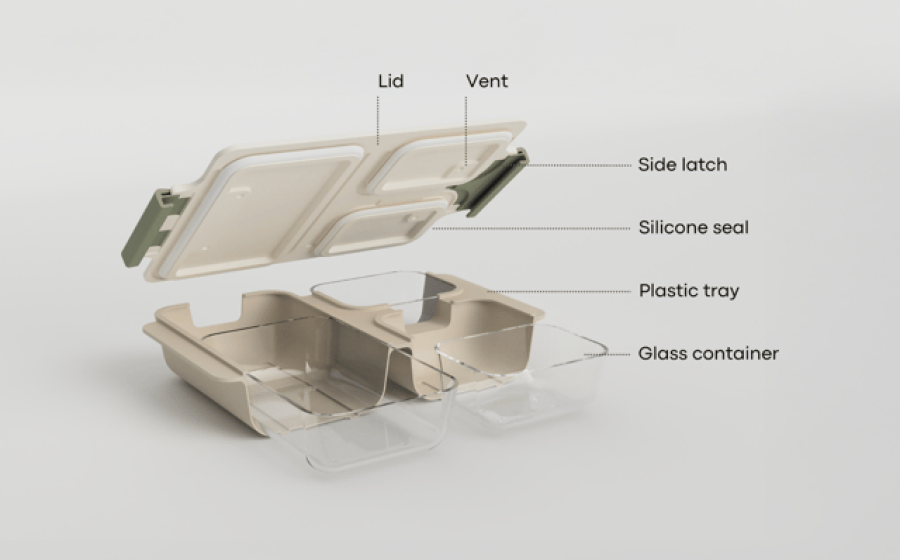
The concept she came up with consists of a plastic tray to secure three glass pull-out containers. A hard plastic lid on top features separate silicone seals to ensure a tight fit. The lid has two hard plastic side latches with silicone vent seals in them as well (which can be seen only in the cross-section).
- The side latches have three functions, Brunke noted: They cover the vent holes in the lids (opening them breaks the seal so you can take the lid off), they attach on the sides to the tray (so there is no way to take the lid off without sliding them open), and they provide an element to grab onto to pull the lid away from the tray. This brief video demonstrates how to open the container: https://www.instagram.com/p/DY2t7YsSvos.
"For now," Brunke says, "I have a working prototype with substitute materials. I haven't yet chosen the exact type of plastic, silicone, or glass since those decisions need to be made with material professionals, ideally with the team that would later manufacture the product."
She acknowledges that she still has improvements to make, as well as modifications such as offering boxes with just one or two containers. To advance the project, she is keen to hear from any companies that might be interested in licensing the project or in cooperating to take the idea to market.
Circular economy logistics for meal delivery services
As for logistics, Brunke notes that just two or three delivery companies dominate the Polish market. She suggests that those firms that do the daily deliveries of the food orders would also collect the previous day's used containers and return them to a central location.
She envisions the following two options:
- A separate middleman company owns the boxes and rents them to the catering companies. At their location, they receive the dirty boxes from the delivery company, clean and sanitize them, and check for any breakage. They then send them to the catering companies, ready to be used according to their needs; or
- The catering companies could invest in their own boxes in the same way that they buy tableware. The delivery company would return the dirty boxes to the catering company. In short, a truck would return the dirty, empty boxes and pick up the fresh boxes. The receiving company then sorts, cleans, and sanitizes the boxes themselves in typical industrial washing machines.
Brunke acknowledges that this would all have to be planned and decided by professionals in logistics, finance, and business. "My academic degree was solely about the design, so that's where the most detail is found. But I'm proud to say that this seems like a viable market idea, and I'm trying to validate it and find partners that would be interested in exploring it."
It seems that the Green Product Awards judges in Berlin agree.