




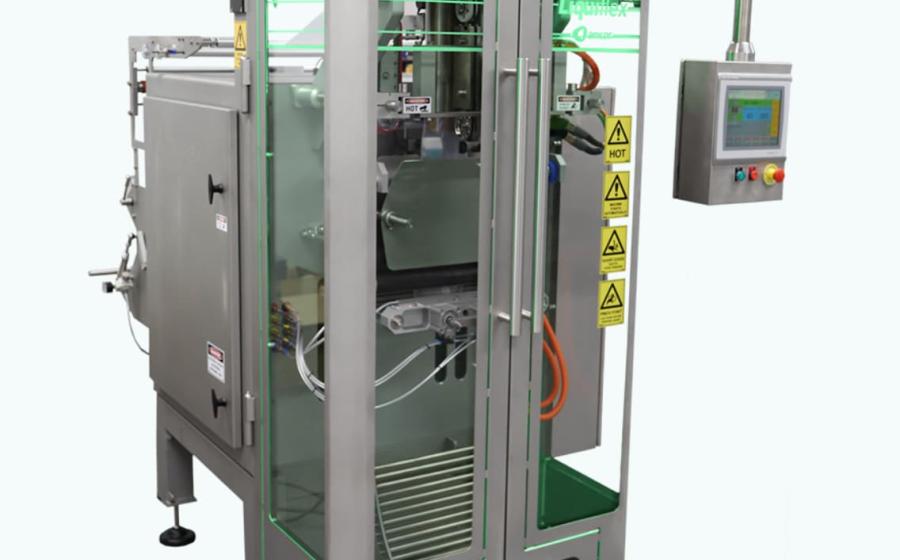

Amcor’s Liquiflex® VFFS packaging system combines compact equipment, rapid changeovers, precise filling and flexible film technology to help foodservice manufacturers improve throughput while reducing waste and packaging complexity.
Amcor has developed the Liquiflex® packaging system, a vertical form-fill-seal (VFFS) solution designed specifically for foodservice applications such as sauces, dressings, soups, condiments, vegetables, proteins and other liquid or semi-liquid products.
The system combines VFFS packaging equipment with Amcor’s Liquiflex® Advance™ films to create zero-headspace, airless pouches, while focusing on production efficiency, flexibility and reduced packaging waste.
Compact footprint with higher output
One of the key features of Liquiflex is its focus on maximizing production capacity within a smaller manufacturing footprint.
According to Amcor, the Liquiflex equipment can deliver 100% more output with a 50% smaller footprint compared with standard VFFS filling machines. This can be particularly relevant for foodservice manufacturers looking to increase capacity without significantly expanding production-floor space.
The system is available in different configurations, including the Liquiflex AV intermittent-motion and CB continuous-motion VFFS platforms, allowing manufacturers to select equipment according to their production requirements.
Faster changeovers reduce downtime
Frequent product and format changes can create significant downtime in food manufacturing operations. Liquiflex addresses this through a quick-change forming collar and integrated impulse film sealer.
Amcor says the system can achieve a 15-minute single-person changeover, without requiring special equipment or tools. The equipment also features recipe-memory functionality capable of storing more than 200 recipes, allowing operators to quickly retrieve production settings for different products and formats.
This combination is designed to make the equipment suitable for manufacturers handling multiple SKUs or frequently changing between product formats.
Designed for zero-headspace foodservice pouches
Liquiflex is designed to produce zero-headspace, airless pouches, which can provide benefits for liquid and semi-liquid food products by minimizing the amount of air remaining inside the package.
The system can handle products distributed through hot-fill, cold-fill, frozen, refrigerated and shelf-stable channels. Applications include salad dressings, salsa, spreads, soups, pickled vegetables, mashed potatoes, liquid eggs, fresh chicken, taco fillings, bakery fillings and specialty dairy products.
Bag formats can range from approximately 6 oz. to 33 lb., giving manufacturers flexibility across portion sizes and foodservice applications.
Precision filling helps reduce product giveaway
For food manufacturers, controlling fill weight is directly linked to profitability. Overfilling can increase product giveaway, while underfilling can create quality and compliance concerns.
Amcor reports that Liquiflex equipment provides precise dosing and sealing to improve fill-weight consistency.
In one case study involving a foodservice condiment manufacturer, Amcor reported improvements including reduced product giveaway, a 30% reduction in unplanned downtime, a 25% increase in throughput and a 75% reduction in waste following the installation of Liquiflex equipment. The same operation reduced changeover time from a multi-person, half-day process to a single-person 15-minute changeover.
These results are application-specific and should not be interpreted as guaranteed performance for every installation.
Liquiflex Advance films complement the equipment
The equipment is designed to work with Liquiflex Advance™ films, creating an integrated packaging system rather than treating the machine and packaging material as separate components.
The film structures are designed to provide strength and abuse resistance while offering barrier protection against oxygen, moisture and light. Available structures include options for medium-to-high barrier performance, with thicknesses ranging from approximately 3.5 mil to 5.5 mil.
Amcor also highlights recycle-ready film options within the Liquiflex portfolio, providing manufacturers with opportunities to reduce material use while maintaining the performance required for foodservice applications.
From sauces to proteins and bakery fillings
The versatility of the platform is one of its notable characteristics.
Liquiflex can be configured for a wide range of foodservice products, including:
- Sauces and condiments
- Salad dressings
- Soups
- Salsa and spreads
- Pickles and peppers
- Diced fruits and vegetables
- Frozen vegetables
- Mashed potatoes
- Liquid eggs
- Fresh chicken and proteins
- Taco fillings
- Bakery fillings
- Dairy custards
- Specialty cheese products
The system can also be customized with options such as ultrasonic sealing, sanitary machine configurations, fitment systems and two-shot/two-phase filling for specialized applications.
Recent developments focus on operator experience
Amcor is continuing to develop the Liquiflex platform. At PACK EXPO International 2026, the company is highlighting the latest Liquiflex VFFS equipment, including the new HMI Optix Panel.
The updated interface is designed to support safety, ease of operation, reporting and productivity, alongside the system's existing capabilities for rapid changeovers, recipe management and accurate weight control.
A packaging system designed around operational efficiency
Liquiflex illustrates a broader shift in foodservice packaging toward integrated equipment + film solutions.
Rather than optimizing packaging machinery and materials independently, the system brings together VFFS equipment, flexible film structures, filling accuracy, sealing performance and changeover efficiency.
For foodservice manufacturers, this can translate into a combination of higher throughput, reduced downtime, lower packaging waste, improved SKU flexibility and better use of production-floor space.
As food manufacturers face increasing pressure to control costs while responding to more varied product formats, technologies such as Liquiflex demonstrate how packaging machinery can become an important part of overall manufacturing efficiency—not simply the final step in the production process.