



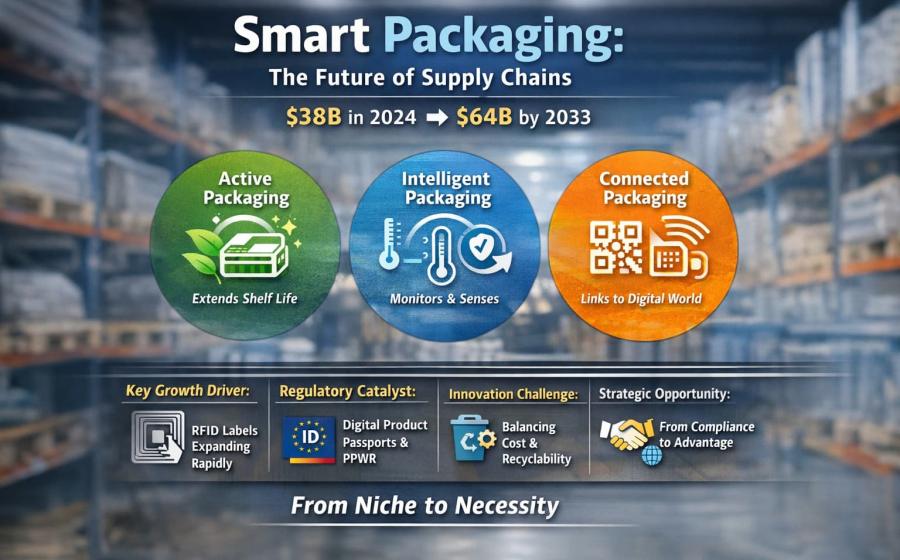

Smart packaging is no longer a futuristic concept confined to pilot projects and innovation labs. It is rapidly becoming a mainstream technology with the potential to redefine how products are protected, tracked, and experienced. With the global smart packaging market projected to grow from $38 billion in 2024 to $64 billion by 2033, the pace of adoption is accelerating and the implications for brands, manufacturers, and regulators are profound.
At the recent Smart Packaging Sprint hosted by Emerald, industry leaders gathered to examine the technologies, market forces, and structural challenges shaping the next decade of smart packaging innovation. The message was clear: smart packaging is transitioning from optional enhancement to strategic necessity.
Why Smart Packaging Matters More Than Ever
Traditionally, packaging has served three basic functions: contain, protect, and deliver. In today’s data-driven and sustainability-focused economy, that is no longer enough.
Smart packaging transforms packaging into a dynamic information layer, enabling it to actively participate in the product lifecycle. It broadly spans three interconnected domains:
- Active packaging – Extends shelf life and preserves freshness, especially for perishable food and pharmaceutical products.
- Intelligent packaging – Uses sensors and indicators to monitor conditions such as temperature, freshness, or tampering.
- Connected packaging – Links physical products to digital ecosystems through QR codes, RFID, NFC, and IoT technologies.
When combined, these functions allow packaging to become the single source of truth supporting food waste reduction, product safety, traceability, digital product passports, and richer consumer engagement.
Market Dynamics and Technology Trends
The Sprint’s technology and market sessions highlighted that adoption is accelerating at the intersection of data availability, regulatory pressure, and consumer trust.
Key trends shaping the market:
RFID labels as a primary growth engine
Pressure-sensitive RFID labels already estimated at around 25 billion units globally are projected to reach 35 billion units by 2027. While Asia dominates production today, driven largely by apparel tagging, growth is accelerating across food, healthcare, and logistics. Food alone is expected to grow at approximately 16% annually, making it one of the most attractive segments.
Diverse technology ecosystem
Ultra-high frequency (UHF) RFID continues to dominate due to its effectiveness in logistics and supply chain visibility. Meanwhile, NFC and QR codes, though smaller in volume, play a critical role in consumer engagement, marketing campaigns, and product storytelling especially at the retail shelf.
Regulation as a catalyst
Europe’s Packaging and Packaging Waste Regulation (PPWR) and the Digital Product Passport initiative are significantly accelerating adoption. From 2026 onward, digital IDs will be mandatory for multiple product categories, setting a precedent likely to influence global regulation. In North America, major retailers are driving uptake through corporate mandates, alongside expanding state-level EPR (Extended Producer Responsibility) regulations.
Cost and recyclability challenges remain
Although component costs are falling, smart packaging still requires meaningful investment in hardware, systems integration, and data infrastructure. Recyclability is another unresolved issue particularly where RFID or NFC components interfere with existing recycling streams. These challenges are creating white space for start-ups focused on low-cost, recyclable, and easily separable smart components.
Corporate Perspectives: Enthusiasm Meets Reality
The Sprint brought together a diverse group of corporates plastic, paper, and metal producers; ingredient suppliers; converters; brand owners across cosmetics, personal care, and food & beverage; and leaders in recycling and waste management. Their perspectives revealed both excitement and realism.
- Consumer goods companies emphasized the dual objective of functionality and experience. Smart packaging is being explored to reduce waste, improve convenience, and enable freshness monitoring while also powering digital storytelling, QR-led engagement, and AI-driven personalization.
- Packaging manufacturers stressed scalability and operational compatibility. Smart features must integrate seamlessly into existing production lines without disrupting throughput or recyclability.
- Waste management and recycling players delivered a critical reality check: end-of-life performance matters. Technologies that look elegant in design often fail in real-world sorting, compaction, and contamination environments.
- Corporate venture and innovation teams expressed strong interest in collaborating with start-ups particularly in areas such as digital watermarks, sustainable sensor materials, and frictionless consumer interfaces.
From Compliance Burden to Strategic Opportunity
One of the strongest themes to emerge was a shift in mindset. Regulation is no longer viewed purely as a cost or constraint, it is increasingly seen as an innovation enabler.
Digital product passports and EPR frameworks are forcing companies to digitize packaging. Once these systems are in place, they unlock entirely new value streams: verified sustainability claims, precision recalls, improved inventory visibility, loyalty programs, and interactive consumer engagement. What begins as compliance quickly becomes competitive advantage.
What’s Next for Smart Packaging?
The conclusion was unequivocal: smart packaging is becoming unavoidable. Regulators demand transparency. Retailers require traceability. Consumers expect interactivity. Brands face growing pressure to reduce waste and prove sustainability claims.
While barriers remain cost, integration complexity, recyclability, and consumer adoption the ecosystem is converging rapidly. The opportunity ahead is substantial.