




Walk into any grocery store and you will find aisle after aisle of food wrapped in a host of different plastics.
Concern about chemicals and plastic in food packaging have been growing in recent years. A recent study reported that over a quarter of the 16,000 chemicals used to make plastic pose risks to human health. Consumers want alternatives without losing the convenience of plastic.
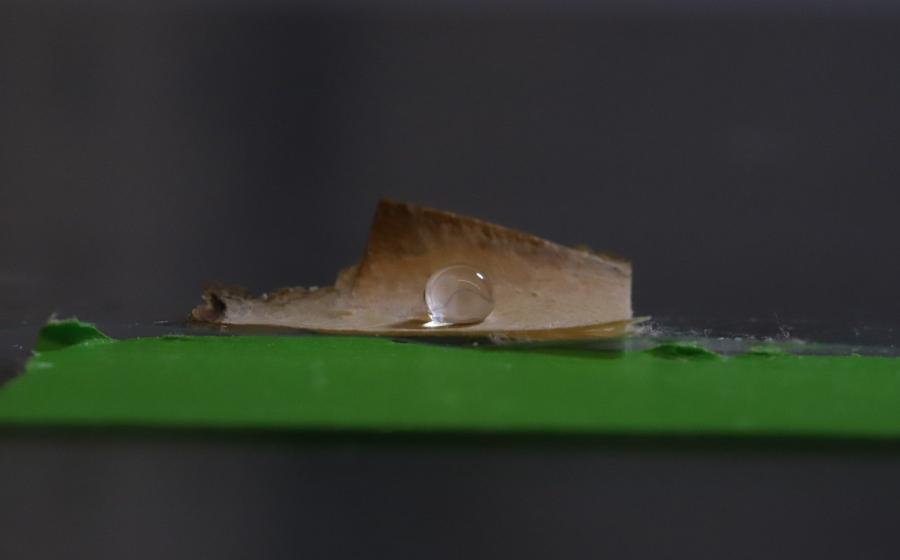
Researchers at the University of Maine looked to nature for a solution. They created a new, water- and oil-proof food packaging material made of mycelium from mushrooms and cellulose nanofibrils (CNFs) from wood that easily decomposes once its purpose is finished.
Mycelium is the root-like system of fungi that hides beneath more visible structures like mushrooms. They create networks that can be miles or millimeters across. What makes them special in packaging is their ability to resist water. Materials made of mycelium have become increasingly popular, serving as a wide range of materials from leather to bricks.
“Plastics are very good at what they do, but then again so were forever chemicals and lead in paints and gasoline,” said Caitlin Howell, UMaine associate professor of bioengineering. “It sometimes takes us a while to understand the long-term impacts of the things we invent, but the good thing is that when we do, we can change. The nice thing about fungi is that we already eat them, so we know that they’re going to be safe for us long-term.”
UMaine researchers have long been invested in CNF materials for their resistance to oils and biodegradable characteristics. CNF is a type of cellulose, a natural polymer derived from plants, which through different processes can be used for an increasingly wide range of applications.
The new material combines CNF with a mycelium coating to capitalize on the advantages from both, water resistance and oil resistance, making a perfect substitute for plastic food packaging.
“Nature has solutions, and as humans, we can look at and adapt to those solutions and better fit it in with our ecosystem, we don’t have to choose plastic,” said Howell.
When researchers give mycelium a material to grow on, in this case CNFs, it naturally tries to grow and fit itself through gaps. “Basically, we try to mimic what they need in nature,” said Sandro Zier, a chemical engineering Ph.D. candidate in Howell’s lab who led the research.
The fungus used for the mycelium coating is grown ahead of time and then blended with a mixture of extra nutrients to help it grow. CNFs are added to that mixture. The blending ensures that the hyphae, the little branching filaments that make up the structure of a fungus, start small and grow uniformly. The malt extract broth fuels the fungus’ growth. The CNFs serve a double purpose, as food for the mycelium and adding their own grease resistant barrier properties.
Once the coating grows and is dried, it’s about 20-25 microns thick, a quarter of the thickness of a human hair. The same process can be used to either apply this coating on top of a material like paper, or it can be used to create a film out of just CNFs and mycelium, which is slightly fuzzy on one side and feels like plastic on the other side.
For this project, researchers selected the fungus Trametes versicolor, or turkey tail mushroom, which grows in decaying trees in the wild. This meant the mycelium could use wood-derived CNFs for its own growth. Similar fungi have been used for things like binding particle boards together.
A major focus of the study was to accelerate the coating process.
“Traditionally when you grow mycelium materials, you need weeks to get anything that you can use,” said Howell. Zier and the research team managed to cut the weeks-long process down to three days. They continue to refine the process to help scale their work.
Improving the scale of production drives down the already low cost of this packaging. Adapting the coating method to common industrial machines could scale the process from square centimeters per hour to square meters per hour. Zier is working with a team of undergraduate researchers to develop a method that utilizes a roll-to-roll system that would increase scale and bring the research closer to commercialization.
The team’s success in using fungus to make more sustainable materials is fueling their excitement for this research.
“Maybe we don’t need the fungus to grow through everything,” said Howell. “Maybe we can just use it on the top as a layer. I think it opens a whole lot of new avenues for creating sustainable materials.”
New sustainable materials are especially important as the need to move away from plastic becomes more prevalent each year with increasing focus on the potential health risks of microplastics and the 19-23 million tons of plastics making their way annually into rivers, lakes and the ocean according to the United Nations.
“Everybody’s contributing here to make materials that are better nature-wise than it was previously,” said Zier. “That’s a big motivation for me. If I go into the ocean, I see plastic. If I want my children to go into the ocean, they shouldn’t see it anymore.”