




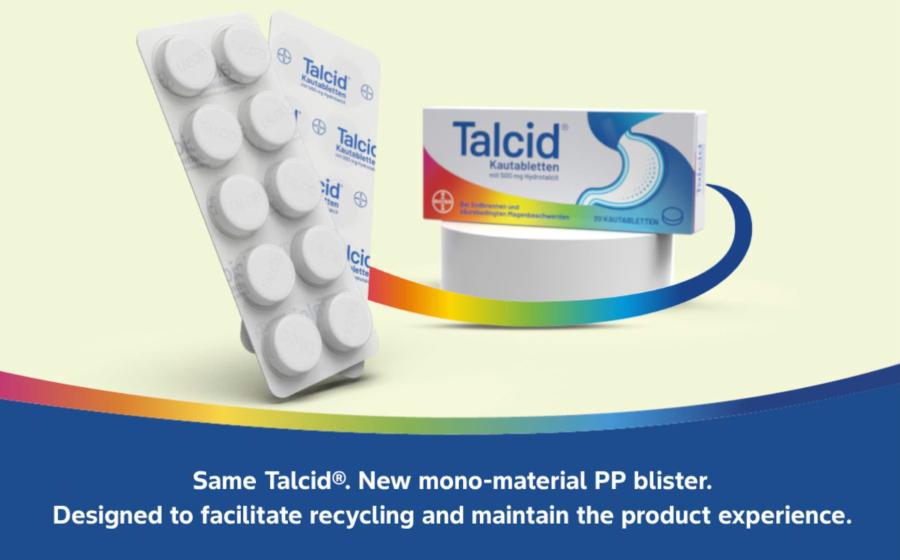

Bayer has launched a mono-material polypropylene (PP) blister for its Talcid® antacid brand in Germany, replacing a multi-material blister structure with a single-material solution designed to improve compatibility with recycling processes. The innovation has received RecyClass Design for Recycling certification and is planned for rollout across 11 additional European markets during 2026–2027.
Tackling the Complexity of Conventional Blister Packaging
Pharmaceutical and consumer-health blister packs have traditionally relied on combinations of materials to deliver the required balance of product protection, barrier performance, mechanical strength, push-through functionality and manufacturability.
However, multi-material structures can create challenges for sorting and recycling at end of life.
Bayer's new Talcid blister takes a different approach by using polypropylene as the primary packaging material across the blister structure, creating a mono-material format intended to simplify the packaging architecture while maintaining the performance requirements of an OTC healthcare product.
The change applies to the packaging only; Bayer states that Talcid's formulation, indication, safety profile, quality and usage instructions remain unchanged.
RecyClass Design for Recycling Certification
A key feature of the new packaging is its RecyClass Design for Recycling certification.
The Talcid mono-PP blister achieved Recyclability Class A and a 98.86% recyclable plastic content score under the RecyClass assessment methodology.
This is significant because the innovation is not simply a material substitution. The packaging has been designed around compatibility with recycling processes, subject to the availability of appropriate collection, sorting and recycling infrastructure in individual markets.
The distinction is important: a packaging design can be technically designed for recycling, while actual recycling remains dependent on local waste-management infrastructure.
Maintaining Pharmaceutical Packaging Performance
For healthcare packaging, sustainability cannot come at the expense of product quality, safety and usability.
Bayer says the new mono-PP blister maintains the product protection and quality expected from Talcid while also supporting intuitive consumer use. The blister's push-through functionality has been retained as part of the new design.
This makes the project particularly relevant from a packaging-development perspective. Moving from a conventional multi-material blister to a mono-material structure requires the material, forming process, sealing system, product protection and consumer-use characteristics to work together.
From Mono-PET to Mono-PP
The Talcid innovation is part of a wider packaging transformation underway at Bayer Consumer Health.
In 2024, Bayer introduced a PVC-free mono-material PET blister for Aleve® in the Netherlands, developed in collaboration with Liveo Research. That solution was reported to deliver a 38% lower carbon footprint per unit, 18% lower packaging weight and lower water and land-use impacts compared with the previous packaging.
The Talcid project demonstrates how Bayer is extending the mono-material design philosophy across different packaging materials and product applications.
While Aleve uses PET and Talcid uses PP, the underlying objective is similar: simplify the packaging structure while maintaining the functional requirements of healthcare packaging.
Collaboration Drives the Innovation
The mono-PP Talcid blister was developed through collaboration across the packaging value chain, combining Bayer's product, quality and regulatory requirements with material and manufacturing expertise.
Bayer worked with Etimex Primary Packaging, whose PURELAY® PP mono-material blister solution was used for the Talcid packaging. The development focused on balancing product protection, everyday usability and a structure designed to support sorting and recycling processes where appropriate infrastructure exists.
This highlights an increasingly important trend in pharmaceutical packaging: sustainable packaging innovation is becoming a multi-disciplinary development exercise rather than simply a material-selection decision.
Germany Launch Sets the Stage for Wider European Rollout
Germany represents a strategically important market for Talcid, accounting for approximately 75% of the brand's European sales, according to Bayer.
Following the initial launch of the mono-PP blister in Slovenia in late 2025, Bayer has now introduced the packaging in Germany and plans a phased rollout across 11 additional European markets during 2026 and 2027.
The planned expansion is particularly relevant because packaging circularity depends not only on packaging design but also on the availability and maturity of recycling infrastructure in each market.
What This Means for Pharma Packaging
Bayer's mono-PP blister represents a broader shift in pharmaceutical packaging development—from optimizing individual packaging components to reconsidering the entire packaging structure and its end-of-life pathway.
The innovation demonstrates several important directions for the industry:
- Mono-material structures can simplify packaging architecture.
- Design for Recycling is becoming an increasingly important development criterion.
- Sustainable packaging must still meet stringent product protection, safety and usability requirements.
- Collaboration between brand owners, material suppliers and packaging manufacturers is critical to scaling new formats.
- Actual circularity requires alignment between packaging design and collection, sorting and recycling infrastructure.
With Bayer targeting additional European markets, the Talcid blister could provide a useful example of how mono-material solutions can move from packaging-development projects toward commercial-scale healthcare packaging applications.
The Bigger Innovation
The significance of Bayer's Talcid blister goes beyond replacing one material with another.
The real innovation lies in simplifying the packaging system while retaining the functional performance expected from a healthcare blister.
As pharmaceutical and consumer-health companies face increasing pressure to improve packaging circularity, solutions such as Bayer's mono-PP blister demonstrate how material simplification, Design for Recycling and performance engineering can come together in a commercially scalable package.
For the pharma packaging industry, the next challenge will be taking such innovations beyond individual brands and markets and building the collection, sorting and recycling infrastructure required to turn design-for-recycling into recycling-at-scale.