



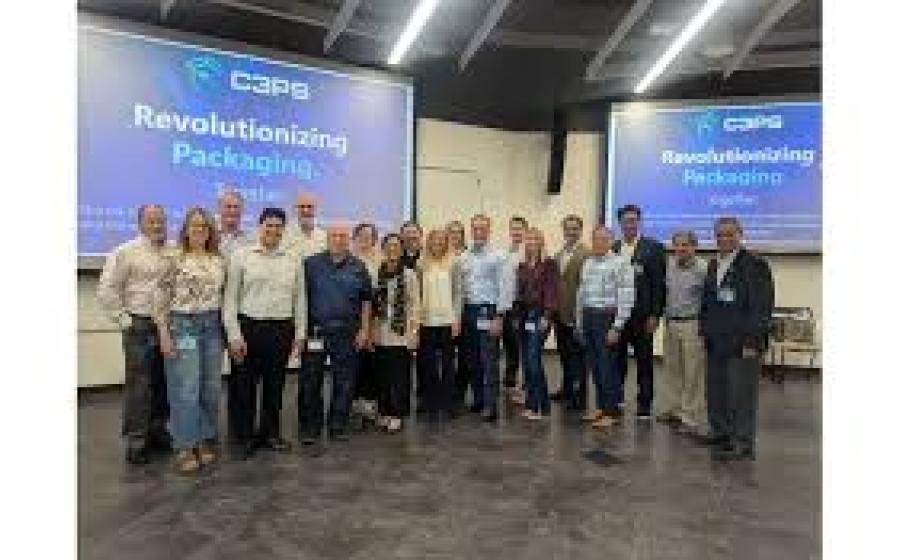

The Center for Plastic, Paper and Hybrid Packaging End-of-Life Solutions (C3PS) was launched in 2025 led by the School of Packaging (SoP) at Michigan State University. It is the first and only National Science Foundation (NSF) Industry-University Cooperative Research Center (IUCRC) dedicated to packaging end-of-life solutions, the SoP says.
In its first 18 months, C3PS has grown into a national network of 12 universities and more than 40 faculty experts all working on problems defined by the packaging industry itself. For member companies, the proposition is direct: pool resources on the fundamental science no single company can justify funding alone, then take the results into their own R&D and turn them into products of their own.
MSU serves as the lead university site and Western Michigan University as the initial partner site. The center currently has 10 industry members and is in “advanced discussions” with six to eight more expected to join by January 2027.
Support from NSF helps establish the collaborative research framework for academia and industry, provides center oversight and institutional support, and creates opportunities for the center to expand through additional university research sites to bring complementary expertise, the SoP notes.
Industry members provide annual membership contributions that fund the shared research portfolio. Under the NSF framework, at least 90% of membership contributions directly support research. Companies participate in the full shared portfolio rather than paying separately for each individual project. Moreover, university partners contribute specialized faculty expertise, laboratories, instrumentation, pilot-scale capabilities and research infrastructure.
“I describe C3PS as a once-in-a-generation opportunity for the packaging industry to benefit from federal investment in shared research infrastructure,” said Muhammed Rabnawaz, C3PS director and SoP professor, in a statement. “I often compare this to public infrastructure. Companies depend on functioning roads, but it would make little economic sense for each company to build its own road network. Similarly, the packaging industry needs a shared scientific foundation upon which companies can build their own competitive innovations.”
C3PS is not another conventional academic research center, but is a strategic innovation platform designed to solve problems that no individual company can efficiently solve alone, Rabnawaz says. The center was established in response to the growing need that sustainable packaging requires coordinated solutions extending beyond the capabilities and commercial interests of individual companies.
Growing industry membership will allow the center to conduct more research, solve more problems and deliver greater value to participating companies. C3PS received more than 30 proposals and funded 10 projects, representing approximately $800,000 in research investment in the first year.
The center’s 10 active projects fall into the following three areas:
- High-performance circular materials, such as oxygen barriers that keep working at high humidity without sacrificing recyclability.
- Recovery of paper, fiber and hybrid packaging. Work here includes PFAS-free barriers for molded fiber, compostable paper coatings and a science-based coated-paper recycling protocol now advancing toward larger-scale trials.
- Focus on the reliability of recycled content and on packaging optimization. Projects use artificial intelligence to predict the quality of recycled PET, apply mechanics-guided design to lightweight corrugated packaging, and use life-cycle assessment to identify ways to reduce carbon footprints.
“We have 10 companies in the group right now contributing proposals and funding, so if we could triple or quadruple that, it means more dollars coming in for research and more research projects being delivered to industry,” said Tom Wetsch, chief innovation officer at Pregis and chairperson of the C3PS Industry Advisory Board, in a statement. “I think we have a good selection process, and we also have a good roadmap to produce results. We want to continue to bring in even more companies, because it’s not really a competitive landscape.
“C3PS is not about competition,” Wetsch continued. “It’s about opportunity from a circular packaging perspective.”
Over the next year, the center aims to grow to about 30 member companies and add at least three additional university research sites. Long-term, C3PS hopes for 30-40% of its members to achieve at least one commercialization outcome.
“I envision C3PS becoming the Silicon Valley of packaging — a national hub where the country’s leading scientific expertise, advanced research capabilities and industry stakeholders come together to solve problems that no company can solve alone,” Rabnawaz said in a statement. “Our success will be measured not by how many research papers we publish or how many members we recruit, but by how many companies turn our science into successful innovations and products, how many future industry leaders we train and how much we contribute to making packaging safer and more sustainable.”