




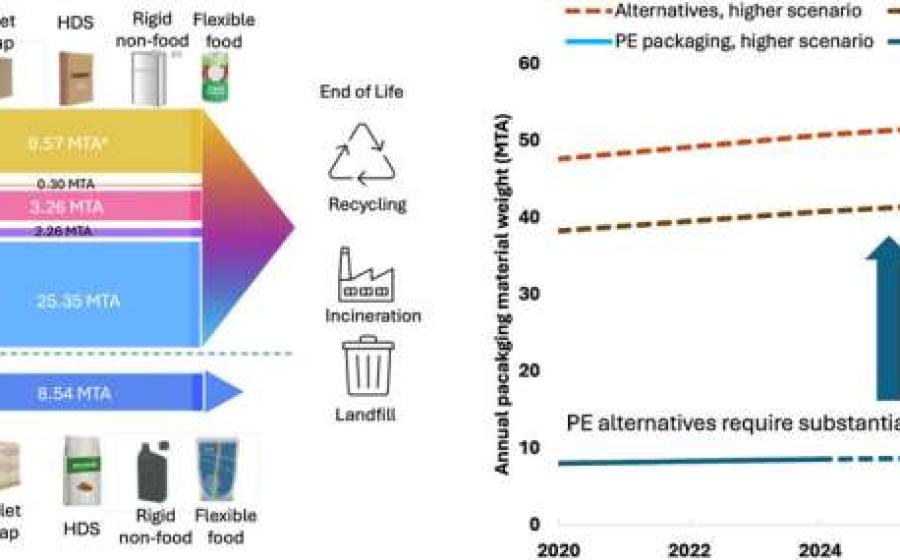

A new research study assessed five major PE packaging applications and organized the analysis around three germane, current questions. How does PE compare with paper, glass, and metal alternatives? How do reuse, post-consumer recycled content, and end-of-life recycling affect the potential environmental impact results? What happens when package-level differences scale to projected demand through 2030 and beyond?
The team, including researchers from the U.S. and Austria, published their findings in the journal Resources, Environment and Sustainability.
PE-packaging often had lower potential environmental impacts
The first finding emerged from the direct comparison of functionally equivalent packaging systems. Single-use PE packaging generally showed lower potential environmental impacts than the assessed paper, glass, and metal alternatives across most environmental impact indicators. In the U.S., PE had lower global warming potential than the alternative in 84% of comparisons. In Europe, this occurred in 68% of comparisons. PE also frequently showed lower impacts for acidification, eutrophication, water-related midpoint indicators, and land use, although results differed by application and region.
"Packaging environmental impact depends on more than whether it is made of plastic, paper, glass, or metal," said Manfred Tacker from the University of Applied Sciences in Vienna and a corresponding author. "The amount of material used, how it is produced and transported, and what happens at the end of its life all influence the environmental outcome."
Life cycle choices matter
The study also examined material choices and how a product's life cycle including packaging impacts are applied in practice. Overall, increasing the use of post-consumer recycled content tended to reduce multiple environmental impacts in both the U.S. and Europe. Nonetheless, higher recycling rates did not consistently reduce potential impacts across all environmental indicators, as outcomes varied by material type, avoided virgin material, and impacts from collection, sorting, and reprocessing.
In Europe, increasing PE pallet stretch wrap film recycling from 41% to 70% reduced global warming potential by up to 15%, but increased eutrophication by up to 21%. Aluminum showed more consistently favorable results when higher recycling displaced impact-intensive primary aluminum production. Reuse presents similar trade-offs. Factors like transport distance, number of rotations, washing, and return logistics significantly influence whether reusable systems are advantageous.
"Reuse and recycling are not single numbers that can be separated from the system around them," said Elizabeth Avery of Trayak, Inc. in Ohio, and a co-author of the study. "The results depend on how often a package is actually reused, how far it travels, cleaning cycles, and what virgin and recycled production is truly displaced by reuse."
By 2030 and beyond, market growth amplifies the consequences of substitution
The third analysis scales the comparison to reflect expected market demand. For the PE packaging applications evaluated, the U.S. demand is forecast to grow by about 30% from 2020 to 2030, while conservative European demand modeling is expected to rise by about 3%.
Material efficiency played a crucial role. In substitution scenarios, replacing PE with alternative material combinations could increase packaging material mass five to sixfold. This change increased modeled global warming potential by about 190% to 280% in the U.S. and 50% to 95% in Europe. Additionally, the analysis indicated possible increases in acidification, eutrophication, fossil resource consumption, water impacts, and land use, with the extent of these effects varying by indicator and region.
"The 2030 and beyond projection shows why scale matters," said Rafael Auras, professor in the Michigan State University School of Packaging and also a corresponding author of the study. "A substitution that seems modest at the individual-package level can require substantially more material when applied across the supply chain and a growing market. That is why future packaging decisions need to consider both material efficiency and expected demand."
Together, the three parts show that packaging life cycle choices cannot be reduced to a material-only decision. Factors such as material efficiency, recycled content, recycling processes, reuse logistics, regional infrastructure, and future demand all influence the results. The researchers suggest that packaging policies and designs should incorporate region-specific, functionally equivalent life cycle data and multiple environmental indicators.
The authors caution that the study does not establish that PE is universally environmentally superior and the environmental impacts would depend on the packaging application under consideration. The study excluded littering, environmental leakage, microplastics, and packaging-related product losses, which remain important considerations for broader assessments. Two panels of independent experts evaluated the original studies to ensure their findings aligned with internationally accepted ISO LCA standards.