





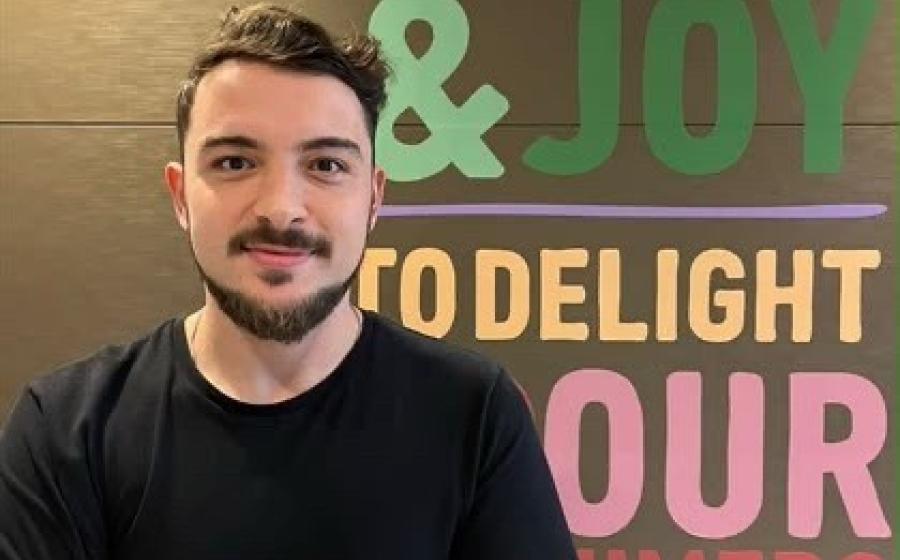
Name: Paulo Ferraz Pires Neto
Designation: R&D Packaging Innovation Lead Latin America and Global Packaging Gums & Candies
Organization: Mondelez International
Questions
Hi, I'm Paulo Pires Neto, 40 years old, based in Curitiba in southern Brazil — with a background in Industrial Design and a postgraduate degree in Design Thinking, which fundamentally shaped how I see problems and approach solutions. I started my journey in 2006 as an intern at Volvo Trucks in Strategic Planning, and in 2007 I jumped into my first packaging development role at Legrand Group — a French electrical and electronics company — where I stayed until 2015. After that I had a brief experience developing TV and monitor packaging for AOC Philips, a Chinese consumer electronics company. For the past 10 years I've been at Mondelez International, where today I hold a dual role: I'm responsible for Packaging Innovation for Latin America across all categories — biscuits, chocolates, gums, candies, powdered beverages — and I also serve as Global Packaging Lead for Gums & Candies, with direct responsibility for brands like Trident and Halls worldwide. My position today is very much connected to strategy, grounded in consumer data and market trends, and linked to the company's needs.
I think large companies face real challenges around cost and speed to deliver new innovations. But packaging has an essential role here — not every innovation needs to be expensive or breakthrough. If we focus on providing great user experience, packaging is doing his main job. The industry needs to evolve by bringing packaging to the beginning of the conversation, not the end. Packaging should be strategic — it needs to start at the strategy table, not just show up at the execution table. We also need to build a culture where innovation in packaging is a continuous practice, not an occasional project. And we need to balance sustainability ambitions with commercial reality — scalable, affordable circular solutions, not just concepts on paper.
I believe Mondelez is heading in the same direction as most major CPG companies. Sustainability is clearly a focus, and meeting local regulations in each country and region is a huge challenge. The laws vary significantly, the infrastructure is at different stages of maturity, and companies need to adapt their packaging strategies accordingly. I see this as one of the biggest hurdles ahead — making sustainability real within the constraints of each market.
Honestly, what excites me is what has always moved me — my genuine passion for packaging and the drive to make projects that truly make sense happen. I believe in putting packaging at the center of the consumer experience and using it as a real growth tool for the business. Sharing knowledge is something that energizes me too — I want the people around me to see innovation not as a one-off project but as a daily exercise, something we practice continuously. My focus is on bringing that innovation and design mindset to everyone I work with, making it part of how we think.
First, think from the outside in — look at the consumer's perspective and market trends before connecting them to the company's ambitions. Too many projects start with "what can we do?" instead of "what does the consumer need and where is the world going?" Second, think of the pack as an ecosystem — there's no point in making a beautiful package if everything else falls apart. Material, shelf presence, and consumer experience all need to be connected and working in harmony. Third, design with purpose — every material choice, every structural decision, every graphic element should have a reason rooted in strategy, sustainability, or consumer insight.
I believe that despite the incredible tools being driven by the evolution of AI, nothing yet replaces human presence and the ability to solve problems with speed. For me, the key to a good relationship between a company and a supplier is closeness and acting as owners of the same problem. Suppliers who thrive are those who stop being order-takers and become true innovation partners — showing up, understanding the challenge, and co-creating solutions instead of just quoting prices. The ones who combine that human proximity with digital capabilities and data transparency will be the preferred partners going forward.
I think the biggest challenge for large CPG companies today is meeting sustainability regulations that vary from region to region. Here in Latin America, specifically in Brazil, we're still on that journey and the challenges are enormous — the infrastructure is developing, the legislation is evolving, and consumer awareness is growing but not yet where it needs to be. On top of that, there's still a gap in consumer research focused specifically on packaging — companies invest heavily in product research but underinvest in understanding how consumers actually interact with and are influenced by the pack.
I truly believe packaging can reach an emotional connection with consumers without necessarily bringing hugely disruptive innovation. Sometimes we can innovate with simple solutions: improving what already works, bringing purposeful graphic design, or reacting quickly to things happening in the market. I also see digitalization playing a very interesting role — not just in production, but in how we research, design, and track trends. The speed that digital tools give us to test ideas, explore design directions, and understand consumer behavior is a game changer. Speaking from a Latin American perspective, I see the Latino consumer as deeply attached to the emotional side and to celebratory dates. Companies that know how to leverage good design solutions, humanized design, digital printing, and connect that with real-time marketing can really stand out.
I believe packaging will always need to fulfill its base function first — protect, preserve, and transport. From there, the possibilities are infinite. I'm a strong believer in the speed of response that companies can give to what's happening in the market and bring that into packaging somehow. The world today is moving incredibly fast — to put it in perspective, everything is happening at WhatsApp 1.5x audio speed — and that means consumers always have a need to see something new. I also believe strongly in serving smaller niches and creating more inclusive and exclusive packs to reach every type of consumer profile. Environmentally, the pressure for truly circular solutions will keep intensifying, and we'll see real scaled infrastructure for collection and recycling, especially in emerging markets. Socially, packaging will carry more of the brand's purpose — consumers will expect it to reflect values like transparency and responsibility.
Maybe creating a community for idea exchange via WhatsApp or Telegram? I think "connections" is right there in the name — we actually met on LinkedIn — so how do we bring passionate packaging people even closer together. Maybe any trends release by region? I love to see how each market works and its own cultures.
AI is already changing how we work, and we're just getting started. In design, it speeds up concept generation and lets you explore structural alternatives rapidly — you can simulate consumer responses before producing a single physical prototype. In production, AI-driven quality control and predictive maintenance are cutting waste and downtime. In supply chains, it enables smarter demand forecasting and supplier matching. But what excites me the most is AI as a research partner — the ability to process massive amounts of consumer data, market trends, and competitive intelligence to inform packaging decisions with a depth and speed that simply wasn't possible before. Still, the human eye and the ability to interpret context will remain essential. AI is a powerful accelerator, not a replacement.
I believe these technologies are incredibly valuable and evolving rapidly. What excites me the most is that consumers are becoming increasingly curious about the origin of their products and the entire production process behind them. Data-driven packaging, smart sensors, and IoT can answer that curiosity — giving transparency from factory to shelf. The key is turning all this data into decisions, not just dashboards.
Automation and robotics are essential for scalability, consistency, and safety. But I think their biggest impact in packaging will be enabling mass customization — as automation becomes more flexible, we'll be able to produce shorter runs, more SKU variations, and personalized packaging in an economically viable way. In logistics, automated warehousing and smart palletization are already changing the game. The important thing is that automation should serve the consumer experience, not just chase cost reduction.
Mondelez has strong commitments around making packaging ready to recycle and reducing virgin plastic. But beyond the targets, what matters most is the design philosophy shift — embedding circularity from the very earliest stages of packaging development, not treating it as a compliance checkbox at the end.
Packaging is the most intimate touchpoint a brand has with a consumer — it's the only medium you literally hold in your hands. I see packaging becoming a real storytelling canvas in the future — through connected experiences, sensory design, and structural innovation that creates moments of surprise. Personalization will go beyond printing names on bottles to creating packs that adapt to occasions, moods, and consumer profiles. And as I mentioned earlier, sometimes brand storytelling through packaging doesn't need to be complex — a well-timed seasonal edition or a clever design reaction to something happening in culture can be incredibly powerful.
The most interesting innovations will happen at the intersections. Material science partnerships — working with biotech companies on new substrates, with chemical companies on advanced barriers. Technology collaborations — integrating NFC, printed electronics, and digital watermarks with converters. E-commerce partnerships — redesigning packaging for the unboxing experience and reverse logistics. And collaborations with data and AI companies to build the intelligence layer that makes packaging smarter. The future belongs to open ecosystems, not closed silos. Nobody will innovate alone.
Don't forget the technical foundation — that's where everything starts. Nothing replaces spending hours on a production line or going through real problems live on the floor. That hands-on experience builds the kind of knowledge that no tool can give you. AI is an incredible tool, but it won't and it can't replace the whole picture. A packaging professional must always have a solid technical base first. With time and maturity, you naturally start absorbing other expertise — business understanding, consumer insights, strategy. But the foundation has to be there. Keep an open mind for innovation — inspiration can come from anywhere, not just from within our industry.
It would be unfair to name just one person, because many people have shaped my career — both on the technical and creative sides. What I can say is that the beginning of my journey was quite challenging. At Legrand, I was the only person focused on packaging inside the local R&D organization. I learned a lot on my own, by staying close to suppliers, and honestly by making a lot of mistakes. Those early years taught me resilience and resourcefulness, and the people I worked with along the way — managers, suppliers, peers — all contributed pieces of who I am professionally today.
Mornings are really important to me. I usually wake up between 6:00 and 6:30. Since I work mostly from home these days — I go to the factory about twice a week — I need my whole house to be in order before I start working. That makes me feel more comfortable and ready to focus. After getting the house sorted (which is not an easy task with a 10-year-old daughter around), I start working earlier than most, trying to stay ahead of the meetings that usually kick in around 9. I keep my phone on silent, minimize distractions, and protect that 7-to-9 window as my most creative and productive time. That's when I do my best thinking and execution. And through all of it — a lot of coffee!
In the same spirit of keeping the house organized, exercise helps me keep a balanced mind for executing my tasks. Beyond that, I like having my desk clean and organized, all tasks written down, and every day I plan what I'll execute that day and what absolutely cannot be pushed to the next. That discipline of daily task management is what keeps my productivity high. It's simple, but it works for me.
What keeps me motivated is literally my passion for packaging — and of course, being able to do my best for myself and my family. A mantra I carry with me is: I don't know how to do everything, but I'm absolutely sure that everything I do, I do with full dedication and willingness. I like to call myself a problem solver. That's what drives me — finding solutions, making things happen, and putting packaging where it deserves to be: at the center.